Special feature
WRC Safari Rally
How a breakthrough Safari win established a future WRC champion
Twenty-five years ago, Richard Burns announced himself as a genuine World Rally Championship contender after taming the wilds of the Safari Rally to become only Britain’s third WRC event winner. As the WRC prepares to tackle the 70th anniversary Safari, Burns’ co-driver and now FIA deputy president for sport Robert Reid recalls how they made history

Tom Howard
Published: Jun 22, 2023, 1:20 PM
Copy link
Share on Viber
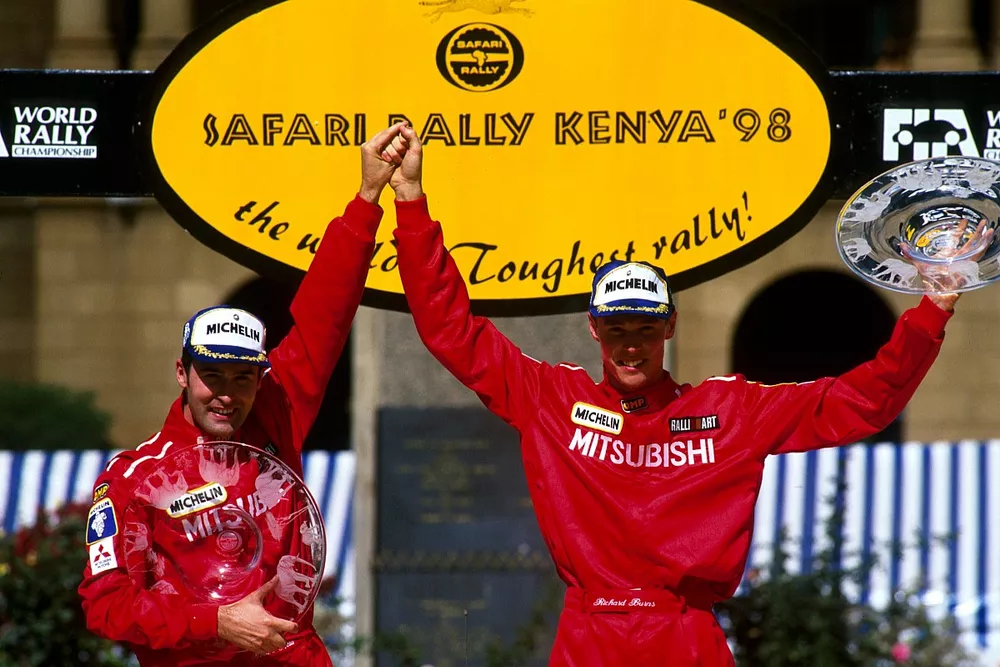
"Richard Burns crossed the final flying finish line, punched the air and shouted something so obscene that the BBC won't be able to show the moment!" That was how Autosport's rally reporter Keith Oswin described Burns' first win of what would become a glittering but unfortunately short World Rally Championship career on the 1998 Safari Rally.
In recent years, this clip of Burns and Robert Reid crossing the finish line has resurfaced, becoming a social media hit that perfectly conveys the overwhelming emotion of succeeding at the Safari Rally. It was pure euphoria emanating from Burns, who had not only conquered one of the most gruelling events in world motorsport, but it just so happened to be the first of 10 WRC wins.
Twenty-five years on and sadly Burns, who succumbed to a brain tumour in 2005, is no longer able to tell the tale. But co-driver Reid sums up a significant moment of their careers succinctly when asked to recall what was also his first WRC win.
"Your first win is very important and very memorable," Reid tells Motorsport.com. "If you were to pick an ideal place to get your first win it would be at your home rally or on an iconic event, and there is no more iconic event than Safari. It is one of the few trophies that I have on display, most of the others are in a container. A big bronze elephant was a very special trophy."
It's a special trophy because, put simply, the Safari Rally is a one of a kind rally. To this day, it remains one of the toughest events in world motorsport. First held in 1953 to mark the coronation of Queen Elizabeth II, the rally was the epitome of driver and machine taking on the harshest of the elements. In its heyday it was a brutal endurance test exceeding 3000 kilometres that lasted an entire week as crews took on the roughest of terrain on open roads that sprawled through Kenya's wildlife-filled savannah.
Back in 1998, the rally was still a 1063-kilometre marathon held on open roads, meaning crews could face the quite incredible and dangerous prospect of oncoming traffic in addition to Kenya's unpredictable wildlife. To limit the dangers, spotter helicopters were deployed to run with cars to warn of any upcoming dangers, but there were still plenty of risks.
Reid recalls: "I remember once getting to the end of a section and saying to Richard, 'We were lucky with that gatepost in the stage'. He said to me, 'What gatepost? That was a giraffe's leg!'
Burns and Reid had to survive plenty of scrapes to reach the finish first in 1998
Photo by: Motorsport Images
"Obviously the helicopter helped a lot. The first couple of years we went, we didn't have the benefit of that. But in 1998 we had a local guy called Glen Edmunds, who was a rally driver out there and he was our spotter in the helicopter. He was very good, he understood Kenya very well and was very helpful.
"The helicopter would be looking for wildlife and often it would go ahead and you would wonder what it was doing, and the next thing you would see it sweeping animals off the road. The helicopter wasn't just your eyes in the sky; they were actively helping and warning of hazards, because at that point it was open roads. Speaking to people in Kenya today, it would be very difficult to do that now, have an open road rally."
Heading into the 1998 Safari, Burns and Reid had been knocking on the door of a maiden WRC win. They had won an Asia Pacific round in New Zealand the previous year and also that season had finished second at the Safari Rally, driving a factory Mitsubishi Carisma GT Evo. This made them victory contenders in 1998, but the list of rivals they would come up against wasn't exactly lacking in the talent department. Among them were his Mitsubishi team-mate and then two-time world champion Tommi Makinen, the Subarus of Colin McRae and Piero Liatti, Toyota drivers Carlos Sainz and Didier Auriol plus the Fords of four-time champion Juha Kankkunen and returning 1981 champion Ari Vatanen.
"We only won three stages interestingly and that was very Richard-esque" Robert Reid
Burns and Reid were somewhat fortunate to finish the recce before the rally had even started.
"At the Safari, the recce tends to be full of stories, more than the rally at times," says Reid. "I remember the recce being quite adventurous. I think we blew an engine and we borrowed Tommi's recce car and we had an accident with it. It was almost a trial getting to the end of the recce, never mind the end of the rally!"
They fared somewhat better than Ford's Bruno Thiry, as a bizarre accident rendered the Belgian unfit to compete. This forced the Blue Oval to hastily recall Vatanen. The rally did, however, start in the best possible fashion for Burns, as the Englishman won the opening super special to emerge with an early lead. Brake issues halted Burns' charge, but he still ended the opening day's 343.85km of stages only 36 seconds behind leader Makinen, while McRae fought back from tyre delaminations to sit 1m48s behind in third.
Heading north of host city Nairobi into Kenya's famous Great Rift Valley for day two provided more trouble for Burns in the form of a slipping clutch. It ultimately dropped the Mitsubishi behind McRae into third, while Ford's Vatanen began to close in. At the front, there was no stopping Makinen, who breezed into a six-minute lead.
Clutch problems held Burns back, but engine woes would sideline his main rivals as Burns kept going
Photo by: Steven Tee / Motorsport Images
Mitsubishi was able to rectify the clutch issue for Burns in service, but the Safari Rally was about to live up to its attritional reputation for his rivals. Sainz rolled his Toyota Corolla out of fourth early in the morning, but somehow his mechanics were able to keep the Spaniard going, although 10 minutes were lost in a repair job that required the crumpled roof to be jacked up.
Subaru was the next to hit trouble. First Liatti suffered an engine failure before the same issue struck McRae's Impreza, leaving the Scot fuming after a second retirement from the first three events. Engine problems also hit leader Makinen, as a broken cam belt put the Finn out of the rally. It handed Burns, still suffering his slipping clutch, a 6m01s rally lead from Vatanen heading into the final day.
A breakthrough victory was far from safe, however, as crews faced 341km of stages on the Sunday. That equates to a whole WRC rally distance by today's standards. The perils of the Safari were all too visible for Burns and Reid after hitting a rock, which damaged the Mitsubishi's sump guard. They also picked up further damage to the front of the car after a run-in with the local wildlife.
"We won the first stage, the super special stage, which I remember being incredibly dusty," says Reid. "We only won three stages interestingly and that was very Richard-esque. From memory, it was bedrock [we hit on the final day]. And because the ruts had formed a bit, there was less ground clearance, so again the car was not as fresh as it was the first time round.
"You just carry on [when something like that happens]. You have to do the best you can on each stage. We had a six-minute lead over Ari on the first stage and by the end it was nine minutes and then he started to take some time from us. It looked as though we were judging it a bit.
"I don't remember being concerned about the car, but I remember being relatively calm, in as much as the Safari Rally can be relatively calm. We were going through sections that we had already done, so there were some ruts appearing and you would crash through them, so there were a couple of scares. We took 99.9% out of the car.
"But getting to the end of the rally, I remember – the last long stage, which was only 48km, a small one by Safari terms, we hit some Guineafowl and damaged the front and the radiator a bit. That was a bit of a scare. You would use everything from the car, and it certainly felt a lot like that."
The first WRC win for Burns and Reid gave them belief they could take the fight to the world's best
Photo by: Sutton Images
It was indeed a scare, but it didn't derail the victory bid. In the end, some of the pressure was taken away as Ford deployed team orders, meaning Vatanen cooled his charge to drop behind full-timer Kankkunen. But Burns and Reid still had to navigate a wounded car through the final stages to clinch the win by 9 minutes and 27s.
Cue that expletive moment of joy as they crossed the finish line followed by some wild celebrations afterwards. The victory meant Burns joined McRae and Roger Clark (RAC, 1976) as British WRC winners and he became the first Englishman to win an overseas WRC round.
"I'm sure it was all the emotion coming out of Richard, he was quite an expert at that," adds Reid, when reflecting on Burns' exuberant celebration. "It was incredible. I didn't realise what history we had made at the time. You would laugh at this now, but I almost had 20 faxes at the hotel from friends saying well done.
"In those days in Kenya, if you wanted to make an international call you had to book one and speak to the operator and say you want to call this number and then they would then call you back. In terms of being able to communicate with friends and family, it was certainly not as easy as it is today.
"Richard was very good at going as quick as he needed to go. I think some people misinterpret that as not being necessarily the fastest" Robert Reid
Short's moustache was a casualty of the victory celebrations, Reid recalls
Photo by: Sutton Images
"We had a big pool party in the hotel and Richard very famously shaved off Phil Short's [Mitsubishi team principal] moustache and Andrew Cowan [Mitsubishi boss] ended up in the pool. It was good fun! You get to the end of any event and it is a relief, but with the Safari it is even more of a relief as you have been there testing, you've had the recce and then the rally. To get to the finish is a huge achievement."
Conquering the Safari wasn't just a breakthrough victory but one that made Burns and Reid believe they could compete with the world's best. The pair went on to repeat the Safari triumph in 2000 driving for Subaru, and lifted the coveted world title in 2001.
"Yeah definitely [it made us believe]," Reid says. "That was the first year that we had actually done the full championship. We had done bits and pieces before, but never a full championship. Safari was always a rally that suited Richard and I, and 1998 was only the fourth time we had done it.
"Richard was very good at going as quick as he needed to go. I think some people misinterpret that as not being necessarily the fastest. If you look at 1999, 2000 and 2001, we had the most number of fastest times than anybody in the championship. He could certainly go quick when he needed to."
As the WRC prepares to tackle the 70th anniversary Safari Rally this weekend - 25 years on from Burns' maiden triumph - Reid believes that, while the rally is more sanitised at 355km, its challenge hasn't diminished.
"It is still a huge challenge and an adventure and it is important we still have that aspect in the championship," he says. "It is a world championship, so we need to go to all the continents and it is incredibly important that we have an event in Africa."
Reid reckons Burns' first victory was an example of only driving as fast as he needed to
Photo by: Sutton Images
We want your opinion!
What would you like to see on Motorsport.com?
Take our 5 minute survey.
- The Motorsport.com Team
Read and post comments
Read also :
Share Or Save This Story
Copy link
Share on Viber
Previous article WRC Safari Rally: Tanak pips Ogier by 0.1s to claim early lead
Next article WRC Safari Rally: Ogier leads as Zebras and tyre issue delay Tanak
Top Comments
There are no comments at the moment. Would you like to write one?
View More & Comment

More from
Tom Howard
Argentina set to make WRC comeback in 2028
WRC
WRC 3 d
Argentina set to make WRC comeback in 2028
Sebastien Loeb tests again as Project Rally One submits WRC homologation papers
WRC
WRC 5 d
Sebastien Loeb tests again as Project Rally One submits WRC homologation papers
More from
Richard Burns
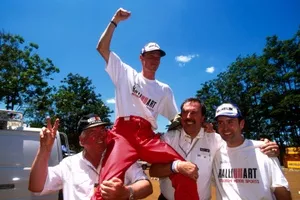
How the much-missed Richard Burns scaled the WRC mountain
WRC
WRC 11 mo
How the much-missed Richard Burns scaled the WRC mountain

Can Meeke revive British interest in rallying?
WRC
WRC Apr 28, 2015
Can Meeke revive British interest in rallying?

British success in the Monte Carlo rally
WRC
WRC Jan 19, 2014
British success in the Monte Carlo rally
Latest news
Joe Gibbs Racing plans to push back on Denny Hamlin retirement timeline
NASCAR Cup
NAS NASCAR Cup 9 h
Joe Gibbs Racing plans to push back on Denny Hamlin retirement timeline
Retaining Liam Lawson isn't enough – Red Bull must stop treating him like a failure
Formula 1
F1 Formula 1 14 h
Retaining Liam Lawson isn't enough – Red Bull must stop treating him like a failure
Yamaha may not be competitive immediately in MotoGP's 850cc era, says Pramac
MotoGP
MGP MotoGP
Qatar GP
18 h
Yamaha may not be competitive immediately in MotoGP's 850cc era, says Pramac
Feature
Discover prime content

Subscribe and access Motorsport.com with your ad-blocker.
From Formula 1 to MotoGP we report straight from the paddock because we love our sport, just like you. In order to keep delivering our expert journalism, our website uses advertising. Still, we want to give you the opportunity to enjoy an ad-free and tracker-free website and to continue using your adblocker.
You have 2 options:
- Become a subscriber.
- Disable your adblocker.
Subscribe now Already subscribed? Sign in here
Already disabled your adblocker?
Reload page
Manage Alerts
Subscribe