Breaking news
Formula E
Gen3 car to be quicker and lighter, with fast-charge pitstops
The Gen3 Formula E car must be capable of reaching a 350kW maximum power, be lighter and smaller, and feature 30-second fast-charging pitstop technology – according to new FIA tender invitations.

Alex Kalinauckas
Edited: Dec 16, 2019, 8:40 PM
Copy link
Share on Viber
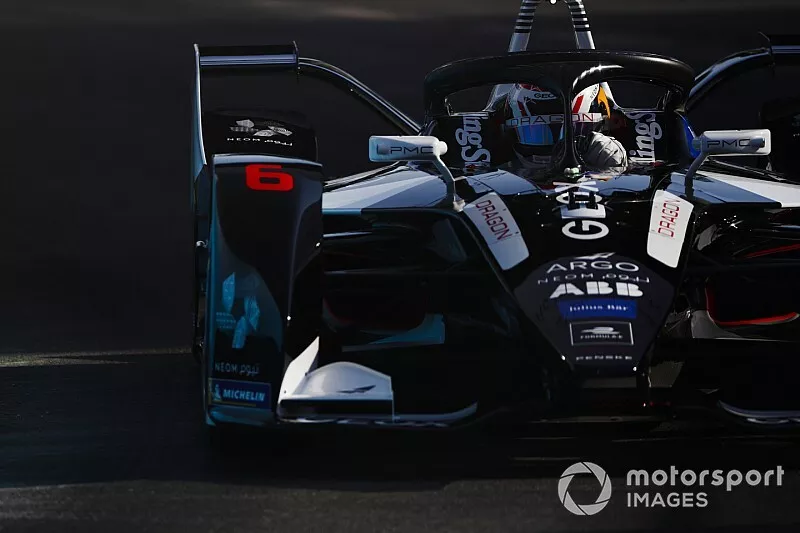
The new car will also feature a standard second powertrain installed on the front axle – but this will not introduce all-wheel drive technology. The governing body has released tender invitations to cover the three seasons that will follow the end of the Gen2 era – 2022-2023, 2023-2024 and 2024-2025 – for the chassis, battery and tyre supply on the Gen3 car.
Companies wishing to bid for these supply deals have until March 31 2020 to submit applications, with the FIA set to make the final selection on 19 June. Once approved, the production timeline for the Gen3 cars will be a design specification approval from the FIA by October 2020, first crash tests by August ‘21, one development car delivered to FE manufacturers by January ‘22 and race car deliveries by August ‘22.
The successful winner of the chassis-supply tender must supply an idea that is “a complete evolution of the chassis architecture, to meet even more challenging weight and dimensional requirements compared with today’s car”, per the FIA chassis tender document.
Read Also:
- Lotterer: New FE rules make for "more civilised" races
- Why achievements of 'lost world champions' still matter
New dimensions
This will reduce the overall dimensions of 1770mm width and 5160mm length on the Gen2 car to 1700mm width and 5000mm length for the Gen3 model, with a new weight target (including the driver) of 780kg – down from the current 900kg. All tender applicants have been asked to provide two technology scenarios to cover varying maximum power aims.
In scenario A, the maximum race power would be 300kW and 350kW with attack mode or fanboost activated, and 350kW in qualifying. Scenario A rear maximum regen power is 350kW and the front is 250kW – in scenario B this is 250kW and 200kW.
Scenario B maximum race power is 250kW, and 300kW in attack mode/fanboost and qualifying. The front powertrain kit “will be used for the sole purpose of regenerating energy during braking and will be common to all cars”.
Fast-charge pitstops
As reported by Motorsport.com, the new car will feature fast-charging pitstop technology – “in order to keep positioning the Formula E world championship as the laboratory of cutting-edge technologies for electric cars”.
The tender documents explain that the Gen3 car must be capable of being fully charged in 45-minutes, with a 30s fast-charge ability – it is unclear if this means fully charged in 30s. The fast-charging technology will mean a change to FE’s sporting rules, with fast-charge pitstops set to be allowed.
Although the FIA documents state “fast-charging sessions will be performed within 30s and one time during the race”, Motorsport.com understands this may not be a mandatory requirement for each driver per race, and those that do come in may not have to charge their cars for the full 30s. The attack mode race format system will continue to be used.
FE will be responsible for providing a bespoke car charging system – “including the energy supply, the distribution network and the charging equipment”.
Read Also:
- Formula E receives FIA world championship status for 2020/21
- Autosport Awards: Vergne scoops Moment of the Year
Open cockpit with halo remains
The Gen3 car will be open-wheeled and open cockpit – with a halo – and the selected chassis supplier will have to build the car to the spec bodykit styling selected by FE and the FIA, as was the case with the Gen1 and Gen2 designs. The car will be rear-wheel drive – with the rear powertrain “part of the car manufacturers’ perimeter and is intended to operate as a motor-generator”.
The FIA document continues: “The front powertrain is common to all cars (delivered as part of the chassis tender perimeter) and operates as generator only.”
The new car will be equipped with hydraulic brake systems on the front wheels only “given the increased regen capability of the car due to increased power regen on the front and the rear respectively”.
The FIA tender application documents state that yearly cost of a complete car will be €340k, with spare part costs not exceeding 135% of that amount. The battery tender requires applicants to “elevate the current car’s battery technology through improved energy density, life cycle, power capability and durability”, per the battery tender application document.
To achieve the 45-minute battery replacement target, battery supply applicants must “work towards upgrading the equipment required for performing this operation (i.e. trolley, etc) to allow for ease of replacement” as part of their application.
Standard charging shall be performed at 80kW, with fast-charging performed at either 450kW or 600kW, “depending on the battery system specifications” of the successful battery supply applicant. The yearly cost of the complete battery system will be €250k.
All-weather tyre supply requirement
Applicants for the tyre supply deal must submit all-weather designs – which FE has used since its first season – that are “for motorsport use and allow for lowest rolling resistance, less tyre wear and optimum handling of the car in all weather conditions”, per the FIA tyre tender document. This continues: “The tyre dynamic behaviour shall be adequate for motorsport used and allow for optimum handling of the car in all weather conditions.”
The tyres must be able to withstand the maximum power levels outlined in scenario A and B, and have wear considerations that mean each driver should not use “more than two new rear and two new front all-weather tyres of the same specification per race”.
Tyre modifications or treatments “such as cutting, grooving, scrubbing-in, the application of solvents or softeners, as well as the fitting of heat retaining devices or preheating” are banned.
The chassis supply documents reveal that the wheel rims the tyres will be fitted too – to be supplied by the chassis provider – will be either 18inches or 20inches. FE currently uses 18inch wheel rims.
The chassis supply documents also state that the cars must be capable of completing “up to 18” races per season, as well as six days of official testing. The tyre tender documents suggest private testing for FE manufacturers will be cut to 13 days per season – although it is unclear when this will come into effect.
For each tender application, the FIA will consider the applicants’ “commitments, actions, credibility and experience” in terms of sustainability and mobility, as well as their ideas of innovation and ability to transfer the technology from motorsport to road cars.
We want your opinion!
What would you like to see on Motorsport.com?
Take our 5 minute survey.
- The Motorsport.com Team
Read and post comments
Read also :
Share Or Save This Story
Copy link
Share on Viber
Previous article Lotterer: New FE rules make for "more civilised" races
Next article Vergne says FE can avoid manufacturer boom and bust
Top Comments
There are no comments at the moment. Would you like to write one?
View More & Comment

More from
Alex Kalinauckas
Who is Kimi Antonelli, F1 sprint polesitter at just 18?
Formula 1
Formula 1 May 3, 2025
Who is Kimi Antonelli, F1 sprint polesitter at just 18?

Why Bottas has the edge over Perez in 2026 F1 return race
Formula 1
Formula 1
Japanese GP
Apr 2, 2025
Why Bottas has the edge over Perez in 2026 F1 return race

What if Red Bull solved its second-car problem with a paint job?
Formula 1
Formula 1
Japanese GP
Apr 1, 2025
What if Red Bull solved its second-car problem with a paint job?
Latest news
TV ratings released for NASCAR Cup season finale
NASCAR Cup
NAS NASCAR Cup
Homestead-Miami
6 h
TV ratings released for NASCAR Cup season finale
Chase Elliott's car chief leaves Hendrick for NASCAR Truck crew chief role
NASCAR Truck
NSTR NASCAR Truck
Homestead
7 h
Chase Elliott's car chief leaves Hendrick for NASCAR Truck crew chief role
“I was getting beat up” – How Daniel Ricciardo burned out on ‘humiliating’ F1 return
Formula 1
F1 Formula 1 11 h
“I was getting beat up” – How Daniel Ricciardo burned out on ‘humiliating’ F1 return
Feature
Discover prime content



Subscribe and access Motorsport.com with your ad-blocker.
From Formula 1 to MotoGP we report straight from the paddock because we love our sport, just like you. In order to keep delivering our expert journalism, our website uses advertising. Still, we want to give you the opportunity to enjoy an ad-free and tracker-free website and to continue using your adblocker.
You have 2 options:
- Become a subscriber.
- Disable your adblocker.
Subscribe now Already subscribed? Sign in here
Already disabled your adblocker?
Reload page
Manage Alerts
Subscribe