Feature
Formula 1 Miami GP
Why the jury is still out on 2026 F1 rules fix
The much-vaunted changes to the energy-management regime had a subtle effect on proceedings in practice and sprint qualifying in Miami – but it’s too soon to declare them a success. And is this as far as F1 can go with the current hardware?

Stuart Codling
Edited: May 2, 2026, 2:19 PM
Copy link

Share on Viber
This week, the FIA’s world motor sport council ratified a range of adjustments to the way Formula 1 cars manage electrical energy around a lap, as agreed by the stakeholders after a series of high-level meetings throughout April.
It’s been known since pre-season testing that changes would be in the offing, but the timescales and priorities have changed in reaction to events. Oliver Bearman’s high-speed accident in Japan, set in motion by a high closing speed relative to Franco Colapinto’s Alpine, put safety at the top of the agenda.
Read Also:
The previous occupant of that position had been what to do about qualifying, given drivers’ complaints that the demands of energy management were preventing them from pushing as hard as they could in qualifying. This sentiment was echoed by the fanbase, which agreed that techniques such as lift-and-coast and super clipping had no part in the bewitching hour.
Sprint qualifying in Miami provided the first glimpse of how effective some of the changes might be. In cutting the recharge limit per lap in qualifying from 8 megajoules to 7MJ for selected events, and increasing the super clipping rate from 250 kilowatts to 350 kW, the FIA sought to reduce the amount of time the cars spent super clipping.
Each circuit is divided into zones where the maximum deployment of 350kW is permitted, while in others it is capped at 250kW.
The battery pack in F1 cars is the bottleneck since it can only store 4MJ. So, the adjustment process has involved a balancing act – cutting back too drastically on permitted recharge would slow the cars down too much, and those responsible for “the show” were naturally wary of the effect on laptimes.
It was a case of aiming for a ‘sweet spot’ where lowering the amount of energy which could be harvested had a meaningful effect on making the recharging process less intrusive, avoiding those pronounced speed drops where super clipping or lift-and-coast became necessary – but without sacrificing too much straightline speed.
With that in mind, the FIA maintained the recharge limit at 8MJ for this event based on the circuit characteristics.
Cars may be at a greater risk of locking up
Photo by: Ryan Pierse / Getty Images
Theory into practice
Simulation data shared by McLaren last week showed how the changes might work, essentially smoothing out some of the peaks and troughs in speed caused by the deployment and harvesting process through the lap. Essentially the aim of the revised regulations has been to trade some of the top speeds observed so far this year for a more natural driving feel: the instant torque punch of the electric motor had been bringing the cars to higher top speeds sooner, but this then tapered off as the charge diminished and had to be recovered somehow.
That ‘somehow’ came in the form of super clipping, where the MGU-K acts as a magnetic resistor against the force of the internal combustion engine while at full throttle on the straights, generating electrical power. Since much of this, along with some of the deployment, was determined by machine-learning algorithms, it reduced the drivers’ influence and frustrated both them and the fanbase.
So, how did these simulations translate into reality? Quite accurately, as it turns out, although the changes didn’t yield the night-and-day difference some may have been claiming.
What was definitely borne out was the prediction that while top speeds on the straights would be lower than they would otherwise have been without the rule tweaks, cars would arrive at braking zones faster. Practice and sprint qualifying on day one in Miami were characterised by plenty of lock-ups into key corners; surface bumps in the track and thermal factors on the tyres were also factors, but Pirelli suggested the new energy-management regime played a part.
How much is difficult to determine. Miami was always going to be a track where the effects of the revised regulations would be subtle, because of the nature of the layout. It has a balance of straights to corners with heavy braking where energy can be harvested unobtrusively – and, as a secondary factor, several acceleration zones where the drivers have to manage traction to avoid thermal degradation of the rear tyres.
The 250kW limit is applied in two zones: the twisting run from Turns 1 to 8 in sector one, then the section between Turn 11 and 16.
“The big impact was mainly on the lock-ups because now we don't have this super clipping anymore, let's say, or it's less evident,” said Pirelli chief engineer Simone Berra.
“So, you reach the corner with higher speed and probably with the old regulation for the power units you would end up with fewer cases of lock-ups. Now you are more on the edge towards, let's say, the grip limit of the tyres.
Valtteri Bottas said he "didn't feel much of a difference"
Photo by: James Sutton / Formula 1 / Formula Motorsport Ltd via Getty Images
“This is the main situation we’ve seen today.”
It might seem quite a small shift to those with an engineering mindset, but seeing F1 cars at the limit of grip ranked among the desired outcomes of the rule changes, so the stakeholders will happily bank it as a win.
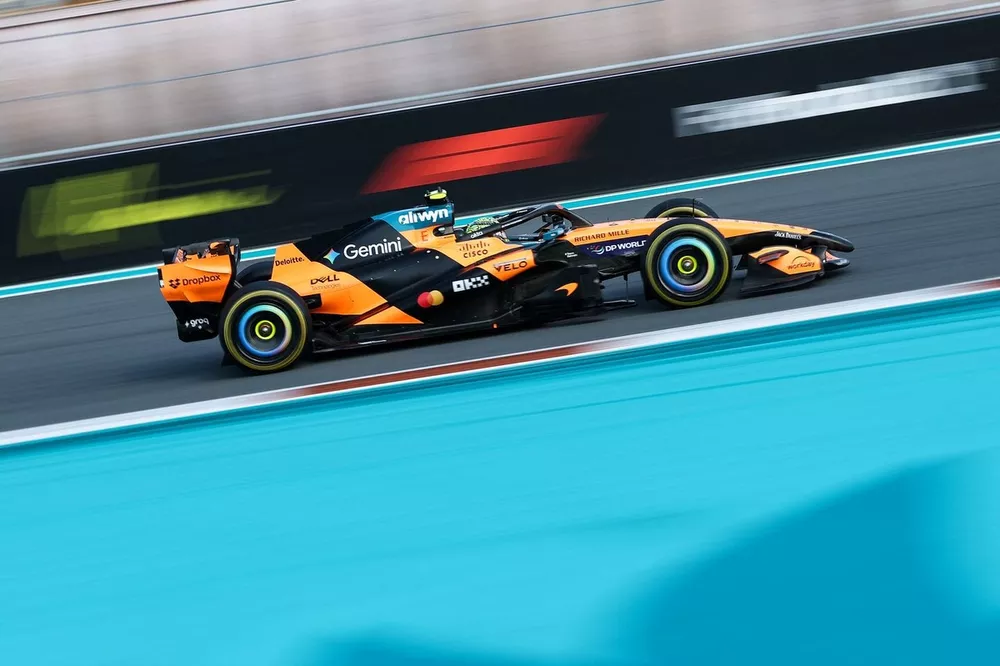
While it’s not possible – with the data available to Autosport – to compare what a qualifying lap around Miami under the revised rules would look like compared with the regime from the first three races, we can look at how much management was going on. Examining Lando Norris’s sprint pole position lap, it’s clear that he was doing a subtle amount of lift-and coast through Turns 4,5 and 6 before getting on the brakes for Turn 7.
A drop in speed from 337km/h to 307km/h between Turn 10 and Turn 11, while at full throttle, suggests a super clip – followed by another brief lift-and coast before braking. The linearity of the speed curve along the back straight also suggests the new rules working as desired, with a more gradual progression to the peak before a gentle tapering from 341km/h to 320km/h.
The overall difference, then, is not transformative – and those drivers who expressed an opinion were somewhat muted.
“In qualifying actually, I didn't feel much of a difference,” said Valtteri Bottas. “It could be different with cars who spend more time on full throttle…”
Given that the next round is Canada, another relatively energy-rich venue, followed by Monaco, where energy management will be borderline irrelevant, the full impact on qualifying of the revised regulations may not be seen until Barcelona. But, again, there is a broad awareness that under the current format of a near-50/50 split of electrical deployment to internal combustion power, compromise is baked into the format – hence the 7MJ recharge cap has been introduced as an ad hoc option rather than a blanket limit.
Real change may have to wait until next year, given talk that a shift to 60/40 is on the table.
“I think it's a step in the right direction for the sport,” said Red Bull team principal Laurent Mekies of the effect of the latest adjustments.
“I think it's probably the best we could have done with the current hardware and I think everyone has been getting on with it quite well.”
Read Also:
Formula 1Why Albon's track-limits strike in F1 Miami GP sprint qualifying came too late
Formula 1Has Mercedes already met its match? Miami F1's complicated form book explained
Formula 1Verstappen: Red Bull's Miami GP updates have "almost halved" gap to F1 frontrunners
We want to hear from you!
Let us know what you would like to see from us in the future.
Take our survey
- The Autosport.com Team
Read and post comments
Read also :

Author Stuart Codling
Stuart studied history at the University of Kent and had a brief career as a road tester on car/bike magazine Redline until he ended up in a ditch with a Ducati 748 on top of him. He joined the Autosport ecosystem as deputy editor of sister title Le Mans & Sportscar Racer in 1999. Most recently he was the editor of GP Racing magazine. He's also the author of 15 books on automobiles and motor racing, including the award-winning Art of The Formula 1 Race Cars. No Ducatis were harmed during its production.
Read more
Previous article Five reasons to watch the Formula 1® Crypto.com Miami Grand Prix 2026 on Apple TV
Next article Will Miami GP start time change? The challenges facing the FIA and F1
Top Comments
There are no comments at the moment. Would you like to write one?
View More & Comment
More from Stuart Codling
War of the words: What will Verstappen and Russell do for an encore?
Formula 1
F1 Formula 1
Las Vegas GP
20 h
War of the words: What will Verstappen and Russell do for an encore?
Who was the biggest loser as Antonelli played draft excluder in Las Vegas?
Formula 1
F1 Formula 1
Las Vegas GP
2 d
Who was the biggest loser as Antonelli played draft excluder in Las Vegas?
Cadillac retaining Bottas for F1 2027 is the logical move
Formula 1
F1 Formula 1
Las Vegas GP
5 d
Cadillac retaining Bottas for F1 2027 is the logical move
The factors behind the abortive 2030 F1 rules announcement
Formula 1
F1 Formula 1
Las Vegas GP
5 d
The factors behind the abortive 2030 F1 rules announcement
What has Cadillac got to lose by picking Herta?
Formula 1
F1 Formula 1
Las Vegas GP
7 d
What has Cadillac got to lose by picking Herta?
What the Brazilian GP revealed about F1's ability to cope with rain
Formula 1
F1 Formula 1
Sao Paulo GP
12 d
What the Brazilian GP revealed about F1's ability to cope with rain
How Formula 1 proved the naysayers wrong – for once
Formula 1
F1 Formula 1
Sao Paulo GP
14 d
How Formula 1 proved the naysayers wrong – for once

How Norris prevailed in a swift errors tour of Interlagos
Formula 1
F1 Formula 1
Sao Paulo GP
15 d
How Norris prevailed in a swift errors tour of Interlagos
Latest news

Max Verstappen considering 2027 Daytona 24 Hours entry
Formula 1
F1 Formula 1
Las Vegas GP
10 h
Max Verstappen considering 2027 Daytona 24 Hours entry
F1 2027 grid: Who will be racing and where?
Formula 1
F1 Formula 1 11 h
F1 2027 grid: Who will be racing and where?

Autosport Business Awards open nominations to recognise excellence across global motorsport industry
Autosport Awards
AWD Autosport Awards 12 h
Autosport Business Awards open nominations to recognise excellence across global motorsport industry

Peugeot quits WEC, Citroen and Opel to wind down Formula E programmes
WEC
WEC WEC 13 h
Peugeot quits WEC, Citroen and Opel to wind down Formula E programmes
Subscribe and access Autosport.com with your ad-blocker.
From Formula 1 to MotoGP we report straight from the paddock because we love our sport, just like you. In order to keep delivering our expert journalism, our website uses advertising. Still, we want to give you the opportunity to enjoy an ad-free and tracker-free website and to continue using your adblocker.
You have 2 options:
- Become a subscriber.
- Disable your adblocker.
Subscribe now Already subscribed? Sign in here
Already disabled your adblocker?
Reload page
Manage Alerts
Subscribe