Analysis
Formula 1
Why the FIA's F1 flexi wing U-turn might backfire
The governing body's decision to impose stricter Formula 1 front wing tests but delay them until the Spanish Grand Prix may not achieve its goals

Filip Cleeren
Published: Feb 4, 2025, 11:26 AM
Copy link
Share on Viber
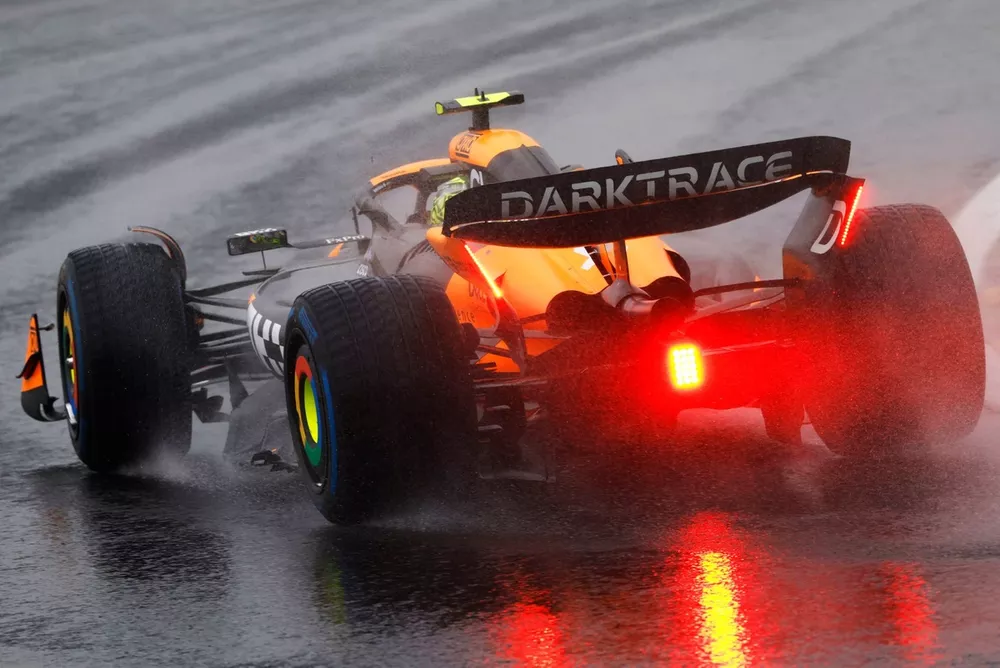
The FIA has changed its stance by imposing stricter tests on F1's controversial flexing wings to avoid the topic causing more drama over the 2025 Formula 1 season, but by delaying their introduction it is guaranteed to remain a talking point.
Until late last season, the FIA's single-seater director Nikolas Tombazis said the FIA was satisfied with the current - if admittedly imperfect - static load tests to keep teams exploiting aero-elasticity somewhat under control. The practice was identified as a key factor behind keeping the current generation of stiff, ground-effect-based cars balanced across high and low-speed corners, with McLaren particularly mastering the practice from its substantial Miami update onwards.
Following rival complaints, the FIA installed extra cameras and stickers in Spa to further monitor what teams were doing, but it decided not to take further action and declared it wouldn't impose stricter tests. Ferrari was particularly aggrieved, as it hadn't developed its own version of the front wings because it expected the FIA to intervene, so it lost several months before working on its own design.
The FIA now made a U-turn after further analysis late last year and informed the teams that it would be changing the tests after all for 2025. Tweaks to the rear wing tests are coming from the start of the season in Melbourne, with a clampdown on front wing flexing following in Spain, race nine of the season on 1 June. The governing body's main desire is to stop the endless discussions about the subject, which dominated agendas over the second half of 2024, and "ensure a level playing field for all competitors to promote fair and exciting racing".
The rear wing test is changing from race one in Melbourne, but it is understood to be largely an exercise in codifying some of the changes the FIA had already asked McLaren and other teams to make in the wake of the papaya team's 'mini-DRS' saga in Azerbaijan, which also raised eyebrows in the paddock. The real big-ticket item remains the front wing test change, with a much-reduced tolerance for flexing on the FIA's measuring points, a reduction by one-third.
Ferrari SF-24 front wings
Photo by: Erik Junius
Why has the front wing change been delayed to June?
The FIA has stated the changes are staggered so that teams who were planning to carry over their 2024 designs wouldn't be forced into discarding their wings and developing new ones for the start of the season.
Motorsport.com understands the stricter tests were initially planned for the start of the season, but there has been significant lobbying from some teams who had already developed flexi-wings to delay the introduction of the new test, initially until Imola and then until Barcelona.
Reports that teams, like Red Bull, are surprised or even furious about the changes are believed to be wide of the mark, as these tweaks were the subject of discussion for some time, so teams knew they were coming and had enough time to react.
But in certain corners, there is still unease over their staggered introduction, with the comprehensive front wing clampdown coming nine races into a 24-race campaign. On the one hand, it allows teams to integrate the FIA's intervention into their early season development cycle, with a circuit like Barcelona often the scene of big upgrade packages in the past.
On the other hand, some smaller teams who haven't fully caught on with flexing front wings feel like the delayed change bakes in the advantage of those who are at the forefront of a practice the FIA clearly sees the need to clamp down on. And while not forcing teams to make changes from race one can be seen as a way to help teams by not having them throw away carryover designs, some of those midfielders will actually have fewer changes to make than the likes of McLaren and Mercedes, and therefore would have benefitted more from a clampdown right from the start.
The other aspect is the looming prospect of wholesale regulation changes for 2026, which is already forcing teams to split their resources and attention. Having to change front wings by June might be an unwelcome and expensive distraction for squads that were looking to fully shift gears to 2026 at an early stage.
Lando Norris, McLaren MCL38, Max Verstappen, Red Bull Racing RB20, Oscar Piastri, McLaren MCL38, Charles Leclerc, Ferrari SF-24, Carlos Sainz, Ferrari SF-24, the rest of the field at the start
Photo by: Steve Etherington / Motorsport Images
How much will this affect the teams, and the 2025 title race?
That depends on who you ask, but one senior team source called the change "proper" and was adamant the teams involved - which along with McLaren and Mercedes is also believed to include the likes of Aston Martin and Alpine - will have to make significant changes in order to comply, not just to the front wing but also to the all-important floor as the front wing design impacts anything downstream.
Given the upturn in performance that turned it from a midfielder into a world champion, a lot of attention will be on how McLaren starts the 2025 season and on how it will then be able to react to the change from Spain onwards, with the team keen to successfully defend its constructors' title without compromising its 2026 ambitions.
Read Also:
Formula 1Lawson gets new race engineer for 2025 F1 season
Formula 1FIA to clamp down on wing flexing in 2025 after U-turn
Formula 1McLaren thinks it can grab 2025 F1 chance without sacrificing 2026
But what the current solution will do is ensure that 2025 will be a two-pronged championship and flexing front wings will remain a talking point, precisely the opposite of what the FIA envisaged. And while mid-season regulation tweaks through technical directives are not that uncommon, in this case, they could have been avoided by either clamping down earlier or letting the issue go through the final year of the current ruleset.
Ultimately, the end result of months of discussions is a compromise. And as is often the case in F1, a compromise isn't designed to make everyone happy. It's designed to make the least number of people unhappy.
We want your opinion!
What would you like to see on Motorsport.com?
Take our 5 minute survey.
- The Motorsport.com Team
Read and post comments
Read also :
Share Or Save This Story
Copy link
Share on Viber
Previous article Las Vegas GP brought forward by two hours as F1 2025 race times revealed
Next article Why Haas F1 won’t use Toyota’s wind tunnel despite technical partnership
Top Comments
There are no comments at the moment. Would you like to write one?
View More & Comment

More from
Filip Cleeren
"It's horribly painful" - Williams drops 2026 car upgrades to benefit 2027
Formula 1
Formula 1
Sao Paulo GP
9 h
"It's horribly painful" - Williams drops 2026 car upgrades to benefit 2027
Latest news
Chase Elliott's car chief leaves Hendrick for NASCAR Truck crew chief role
NASCAR Truck
NSTR NASCAR Truck
Homestead
38 min
Chase Elliott's car chief leaves Hendrick for NASCAR Truck crew chief role

“I was getting beat up” – How Daniel Ricciardo burned out on ‘humiliating’ F1 return
Formula 1
F1 Formula 1 4 h
“I was getting beat up” – How Daniel Ricciardo burned out on ‘humiliating’ F1 return

Myers Riley Motorsports adds Andretti alongside returning Fraga for 2027 IMSA GTD campaign
IMSA
IMSA IMSA 5 h
Myers Riley Motorsports adds Andretti alongside returning Fraga for 2027 IMSA GTD campaign
Feature
Discover prime content

Top 10 F1 cars of the 1970s
Formula 1
By Kevin Turner
Top 10 F1 cars of the 1970s


Subscribe and access Motorsport.com with your ad-blocker.
From Formula 1 to MotoGP we report straight from the paddock because we love our sport, just like you. In order to keep delivering our expert journalism, our website uses advertising. Still, we want to give you the opportunity to enjoy an ad-free and tracker-free website and to continue using your adblocker.
You have 2 options:
- Become a subscriber.
- Disable your adblocker.
Subscribe now Already subscribed? Sign in here
Already disabled your adblocker?
Reload page
Manage Alerts
Subscribe