Feature
Formula 1 Miami GP
Where will ‘yo-yo’ F1 racing return?
The ratio of quality to quantity shifted in favour of hard-earned overtakes in Miami, but this was a result of deeper factors in play than the recent rule changes

Stuart Codling
Published: May 6, 2026, 8:35 AM
Copy link

Share on Viber
After a static sprint event on Saturday which prompted no less an eminence than Tiff Needell to rant on social media about why the folk in the grandstands hadn’t turned up for the Formula 2 race, Sunday’s Miami Grand Prix offered rather more drama.
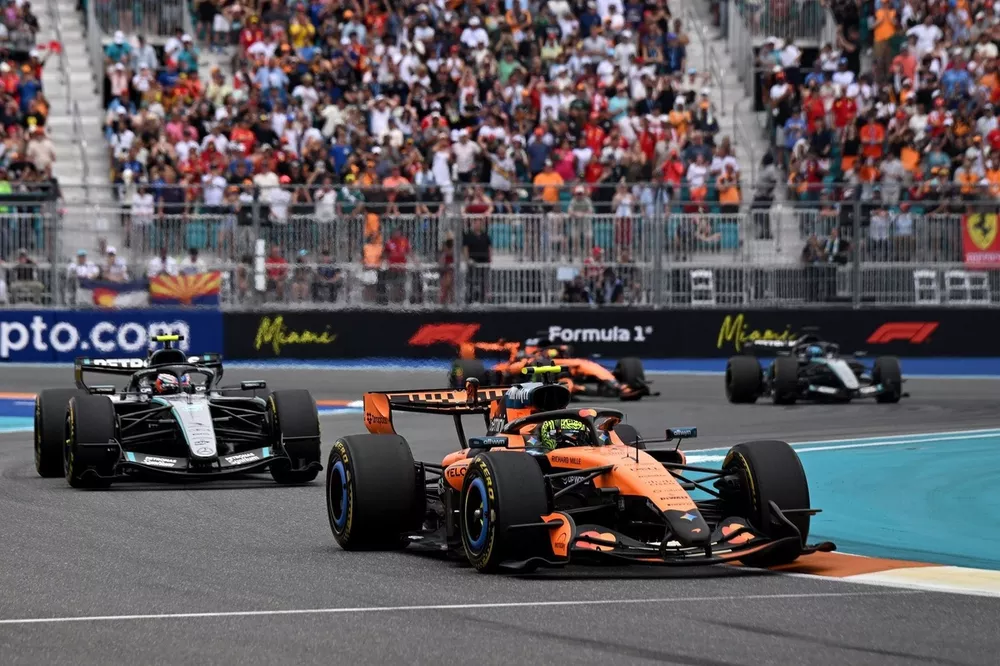
Pleasingly, there was relatively little of the so-called ‘yo-yo racing’, triggered by disparities in battery charge levels, which has become a polarising feature for F1’s fanbase. Although Lando Norris was advised by his McLaren race engineer Will Joseph to sit back and allow the yo-yo battle for the lead between Charles Leclerc and Kimi Antonelli to play out in the early stages, most of the passing was of the earned variety.
But how much of this was a result of the tweaks applied to electrical harvesting and deployment levels this weekend? Less than you might hope.
The changes applied to races were less extensive than those governing qualifying and wet-weather protocols, since the general consensus among the stakeholders remains that the racing is not a problem to solve, and yo-yo passing is a feature rather than a bug. Boost mode has been limited to 150 kilowatts in race conditions, while electrical deployment is permitted at 350kW in defined “key acceleration zones” but capped at 250kW elsewhere on the lap.
This has been done for safety rather than to enhance the spectacle, reducing scenarios where cars encounter one another at vastly different speeds because of disparities in electrical deployment and charge.
“It's improved a little bit,” said Leclerc of the effect of the rule changes. “The battles in itself, I don't think changed massively.
“I think the fact that it was so warm, being behind you overheat quite quickly the tyres, and that made it very difficult for me to be closer compared to the first two or three races. So it’s probably a bit more dependent on today, but let’s see.”
Charles Leclerc, Ferrari, George Russell, Mercedes
Photo by: Andy Hone/ LAT Images via Getty Images
Over the first few races the general commentary had been that it was easier for the new cars to follow one another through corners than it had been for the previous ones – at least in comparison with the final iteration of the ground-effect cars. One of the key targets for that formula had been to make following through corners easier, creating more overtaking opportunities, but by last season performance convergence combined with increased wake turbulence to scupper this aim.
Read Also:
In Miami the circuit layout and ambient temperatures made following a problem again. Drivers had to manage tyre temperatures, particularly on the rear axle because several corner exits demanded lots of traction. Engine temperatures also began to spike when cars were following one another.
The layout of the track also had a funnelling effect on electrical deployment choices. There was some scope to use a little more power during the opening sector, and the start/finish straight, but mostly it boiled down to a choice between taking extra top speed on the run between Turns 10 and 11 or the back straight. This was the key to the ‘optimal lap’.
Other drivers commented on the ineffectiveness of overtaking mode, which unlocks an extra half-megajoule of deployable energy when a car is within one second of the car ahead. If the car ahead also has overtake mode available, it becomes analogous to the previous era of the Drag Reduction System (DRS), where the car behind was able to drop a rear wing plane and gain more speed in defined areas of the track.
If several cars were all within a second of one another, the advantage was negated.
“Everything is a bit better,” said Carlos Sainz. “I think we just need to find a solution when the car in front is also in overtake mode. Overtaking is impossible. I think it's very similar to the DRS train.
“Maybe we could find something. The [yo-yo] racing has never really been the problem of these regulations.”
Pierre Gasly, Alpine, Carlos Sainz, Williams
Photo by: Steven Tee / LAT Images via Getty Images
So it would be premature to say F1 has freed itself of “artificial” overtakes. They have merely gone on hiatus until the calendar reaches a track where the layout and conditions offer more deployment options. Fortunately this point will not arrive until summer.
“I would say Montreal would be more challenging to pass than here,” said George Russell. “Because you've got two clear straights where you're going to deploy all of your energy. And all of the drivers are going to be using that same strategy.
“Whereas tracks like Melbourne, or maybe when we get to Silverstone, where you can deploy at different places, you'll probably see a bit more of this yo-yo racing.
“But Montreal, I think, with the current rule set, will probably be a bit of a challenge again.”
Read Also:
We want to hear from you!
Let us know what you would like to see from us in the future.
Take our survey
- The Autosport.com Team
Read and post comments
Read also :

Author Stuart Codling
Stuart studied history at the University of Kent and had a brief career as a road tester on car/bike magazine Redline until he ended up in a ditch with a Ducati 748 on top of him. He joined the Autosport ecosystem as deputy editor of sister title Le Mans & Sportscar Racer in 1999. Most recently he was the editor of GP Racing magazine. He's also the author of 15 books on automobiles and motor racing, including the award-winning Art of The Formula 1 Race Cars. No Ducatis were harmed during its production.
Read more
Previous article Exclusive: The story behind Red Bull and Verstappen's F1 turnaround in Miami
Next article Why time is running out to make bigger F1 power unit changes for 2027
Top Comments
There are no comments at the moment. Would you like to write one?
View More & Comment
More from Stuart Codling
What the Brazilian GP revealed about F1's ability to cope with rain
Formula 1
F1 Formula 1
Sao Paulo GP
3 d
What the Brazilian GP revealed about F1's ability to cope with rain
How Formula 1 proved the naysayers wrong – for once
Formula 1
F1 Formula 1
Sao Paulo GP
5 d
How Formula 1 proved the naysayers wrong – for once
How Norris prevailed in a swift errors tour of Interlagos
Formula 1
F1 Formula 1
Sao Paulo GP
5 d
How Norris prevailed in a swift errors tour of Interlagos
"He really wanted it" – understanding Russell's rage over aborted ‘pole' lap in Brazil
Formula 1
F1 Formula 1
Sao Paulo GP
6 d
"He really wanted it" – understanding Russell's rage over aborted ‘pole' lap in Brazil
F1 Brazilian GP: Antonelli quickest in FP2
Formula 1
F1 Formula 1
Sao Paulo GP
7 d
F1 Brazilian GP: Antonelli quickest in FP2
LIVE: F1 Brazilian GP updates - Final practice under way; Verstappen, Leclerc and Hamilton among drivers with grid penalties
Formula 1
F1 Formula 1
Sao Paulo GP
6 d
LIVE: F1 Brazilian GP updates - Final practice under way; Verstappen, Leclerc and Hamilton among drivers with grid penalties

LIVE: F1 Brazilian GP updates - Norris splashes to pole from Russell
Formula 1
F1 Formula 1
Sao Paulo GP
6 d
LIVE: F1 Brazilian GP updates - Norris splashes to pole from Russell
LIVE: F1 Brazilian GP – Norris wins from Verstappen in the rain
Formula 1
F1 Formula 1
Sao Paulo GP
5 d
LIVE: F1 Brazilian GP – Norris wins from Verstappen in the rain
Latest news
The numbers that reveal how MotoGP sprint races have decided the title fight
MotoGP
MGP MotoGP
Qatar GP
1 h
The numbers that reveal how MotoGP sprint races have decided the title fight
How seizing every chance – and making it happen – keeps Gasly’s fire burning
Formula 1
F1 Formula 1 4 h
How seizing every chance – and making it happen – keeps Gasly’s fire burning
McLaren to upgrade MCL40 F1 car at its bogey track Las Vegas
Formula 1
F1 Formula 1
Las Vegas GP
5 h
McLaren to upgrade MCL40 F1 car at its bogey track Las Vegas
The surprising convergence behind F1's increasingly competitive 2026 season
Formula 1
F1 Formula 1 21 h
The surprising convergence behind F1's increasingly competitive 2026 season
Subscribe and access Autosport.com with your ad-blocker.
From Formula 1 to MotoGP we report straight from the paddock because we love our sport, just like you. In order to keep delivering our expert journalism, our website uses advertising. Still, we want to give you the opportunity to enjoy an ad-free and tracker-free website and to continue using your adblocker.
You have 2 options:
- Become a subscriber.
- Disable your adblocker.
Subscribe now Already subscribed? Sign in here
Already disabled your adblocker?
Reload page
Manage Alerts
Subscribe