Analysis
Formula 1
Tech analysis: Why cooling became Mercedes' Achilles heel in Russia
Mercedes is really under pressure for the first time in four years, as Ferrari looks to drive home an unexpected early season points advantage, forcing the Silver Arrows to respond to the challenge.
Matt Somerfield Giorgio Piola
Edited: May 6, 2017, 6:00 PM
Copy link
Share on Viber
Giorgio Piola's F1 technical analysis
Giorgio Piola is the preeminent Formula 1 technical journalist. View our full selection of Giorgio's technical illustrative content
Both Mercedes cars struggled noticeably with overheating issues during the Russian Grand Prix. And although Valtteri Bottas was able to take the win thanks to being in clean air at the front, Lewis Hamilton's woes showed it could have been a different story if Ferrari had been ahead from the start.
The Mercedes situation was not helped by race day being hotter than forecasts had predicted. The temperature swing was enough to tip Mercedes out of its comfort zone, but if the team had not been in such a close battle with Ferrari, would the Brackley-based outfit have been more reserved in its choices?
After all, teams have numerous cooling packages available to them throughout the year, each configuration a compromise based on circuit specificity and temperature fluctuations between qualifying and the race.
Each of these packages comes with its own cooling advantages and aerodynamic drawbacks, as the more you open up the bodywork, the less efficient it becomes - especially at higher speeds.
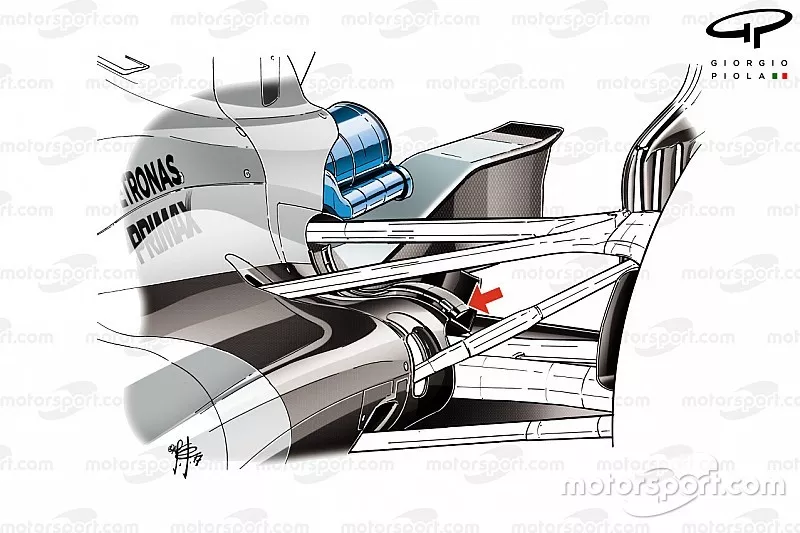
The rear end cooling package ran by Mercedes in Russia utilised a perforated gurney flap on the trailing edge of the cooling outlets (arrowed).
These gurney flaps are used to help the region create a little more downforce, of which the perforation is present to allow some of the high pressure of the upper surface to bleed into the low pressure region behind, allowing it to operate at a wider angle of attack.
The acceleration of this airflow around the trailing edge of the cooling outlet should also result in a suction effect on the air flowing through the cover, improving the car's overall cooling efficiency.
Mercedes W08 rear end comparison
Photo by: Giorgio Piola
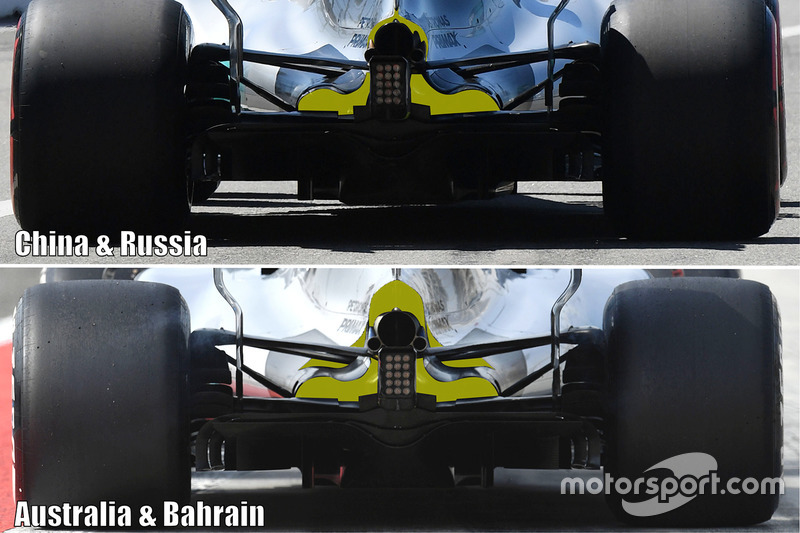
This is with all things being equal though, with this configuration optimised for a certain cooling threshold before being superseded by a larger cooling outlet, such as the one used in Australia and Bahrain.
This larger cooling outlet comprises a revised upper section to the engine cover with cutouts around the upper wishbones and a larger hood over the exhaust - albeit it can be run without the hood, as Hamilton did so in Australia.

Mercedes F1 W08, T-wing
Photo by: Giorgio Piola
The other major cooling solution we’ve seen Mercedes introduce this season is its shark fin cooling chimney (above), which was used in Australia and Bahrain but replaced with a normal shark fin engine cover for China and Russia.
Heat created under the cover is released out the top of the chimney in unison with the rearward cooling outlet, giving much more scope for heat rejection.
Heat soak
Temperature miscalculations aside, there are two other question marks over Mercedes performance in Russia that can be answered by other scenarios that unfolded.
Firstly, we know both Mercedes drivers were said to be struggling with temperature management but it appeared that Hamilton suffered a little more.
This can be partly put down to the Brit running behind the Ferrari cars, whilst Bottas moved along in free air, with the SF70H of Raikkonen creating turbulent airflow that becomes less effective as it passes around and through the W08.
This is a problem that is exacerbated by the 2017 regulations, with the point at which the wake affects a trailing car moved rearward. It's something we’ve noted by the drivers' comments of the cars being less aerodynamically stable as they approach another competitor.
The other issue was the aborted start, prompted by Fernando Alonso’s early withdrawal from the race, which meant car temperatures increased as the Mercedes cars sat soaking it up, waiting for the rest of the grid to form up behind them before doing a second formation lap.
You might argue that this surely affected Ferrari just as much, given its front row lockout, but it appears that the team didn’t suffer from the same cooling miscalculation.
We want your opinion!
What would you like to see on Motorsport.com?
Take our 5 minute survey.
- The Motorsport.com Team
Read and post comments
Read also :
Share Or Save This Story
Copy link
Share on Viber
Previous article Nasr worried about Brazil's F1 legacy
Next article Weekend Debate: Could Fernando Alonso and Formula 1 emerge as winners from the Indy 500?
Top Comments
There are no comments at the moment. Would you like to write one?
View More & Comment

More from
Matt Somerfield

Gallery: How F1 tech evolved during the 2024 season
Formula 1
Formula 1 Dec 31, 2024
Gallery: How F1 tech evolved during the 2024 season
How McLaren’s rear wing push changed the game in F1
Formula 1
Formula 1 Dec 20, 2024
How McLaren’s rear wing push changed the game in F1
How 2026 F1 rules will help avoid identikit designs
Formula 1
Formula 1 Dec 16, 2024
How 2026 F1 rules will help avoid identikit designs

More from
Mercedes
Lando Norris: Mercedes “at a different level” in Qatar
Formula 1
Formula 1
Qatar GP
1 h
Lando Norris: Mercedes “at a different level” in Qatar
How Nico Rosberg beat Lewis Hamilton – and his demons – to clinch F1 world title
Formula 1
Formula 1
Abu Dhabi GP
12 h
How Nico Rosberg beat Lewis Hamilton – and his demons – to clinch F1 world title
Latest news
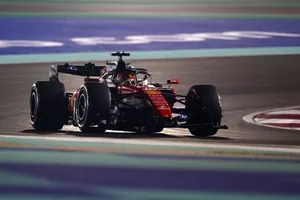
Charles Leclerc explains Qatar GP practice spin after painfully "slow" day for Ferrari
Formula 1
F1 Formula 1
Qatar GP
1 h
Charles Leclerc explains Qatar GP practice spin after painfully "slow" day for Ferrari
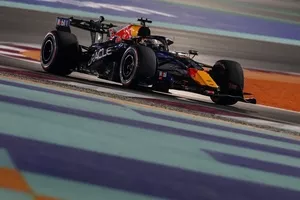
Max Verstappen feels a “disconnect” as Red Bull looks to solve “massive limitation” in Qatar GP practice
Formula 1
F1 Formula 1
Qatar GP
1 h
Max Verstappen feels a “disconnect” as Red Bull looks to solve “massive limitation” in Qatar GP practice
Lando Norris: Mercedes “at a different level” in Qatar
Formula 1
F1 Formula 1
Qatar GP
1 h
Lando Norris: Mercedes “at a different level” in Qatar
Feature
Discover prime content



Top 10 F1 cars of the 1990s
Formula 1
By Kevin Turner
Top 10 F1 cars of the 1990s
Subscribe and access Motorsport.com with your ad-blocker.
From Formula 1 to MotoGP we report straight from the paddock because we love our sport, just like you. In order to keep delivering our expert journalism, our website uses advertising. Still, we want to give you the opportunity to enjoy an ad-free and tracker-free website and to continue using your adblocker.
You have 2 options:
- Become a subscriber.
- Disable your adblocker.
Subscribe now Already subscribed? Sign in here
Already disabled your adblocker?
Reload page
Manage Alerts
Subscribe