Analysis
Formula 1
Tech analysis: Has new philosophy helped make Ferrari real favourite?
The SF70H is perhaps the most complete design we've seen come out of Maranello in the last decade, with its previous challengers seemingly far too focused on individual concepts.
Matt Somerfield Giorgio Piola
Edited: Mar 8, 2017, 12:27 PM
Copy link
Share on Viber
Giorgio Piola's F1 technical analysis
Giorgio Piola is the preeminent Formula 1 technical journalist. View our full selection of Giorgio's technical illustrative content
The car, however, seems to have a more holistic and innovative feel to it, and its performance so far in testing has led to Lewis Hamilton labeling the Italian squad as the real favourite for the start of the season.

Ferrari SF70H and SF16-H front view comparison
Photo by: Giorgio Piola
The team has taken a very different approach to its rivals when it comes to dealing with the way airflow is interrupted as it passes by the suspension elements, and while the likes of Mercedes and Toro Rosso have gone to the effort of raising their suspension to clear a path for air to move under and around the sidepod, Ferrari has taken a different approach.
The front comparison of the SF70H and SF16-H shows us that Ferrari has made a concerted effort to place the sidepod inlets much higher, clearing a path above the suspension for air to flow into them.
This also tidies up the area ahead of the sidepod for the more complex bargeboards and turning vanes that are allowed this season, complementing the much taller and aggressive sidepod undercut, which like the inlet is set back to take advantage of the pre-conditioning devices being employed.

Ferrari SF70H turning vanes, detailed
Photo by: Giorgio Piola
The front of the sidepods have a very interesting shape as the team has moved back their leading edge, masking the front of the sidepod inlet with numerous airflow conditioners in order to work the airflow into the inlet and around the sidepod more efficiently.
The inlet consists of two distinct apertures, the regular forward-facing one and another on top of the sidepod (blue arrows) which takes advantage of how air flows around the horizontal part of the airflow conditioner.
This upper inlet is about feeding the framework placed around the radiator, improving how efficient it is at cooling whilst speeding up the flow of air through the sidepod.
The rest of the airflow conditioner's shape is designed to improve flow into the main inlet and encourage flow around the sidepods shoulder.
The large rhomboid-shaped conditioner has two horizontal slots in its surface to create a vortex as the differing pressures collide, improving performance at the floor's outer edge.

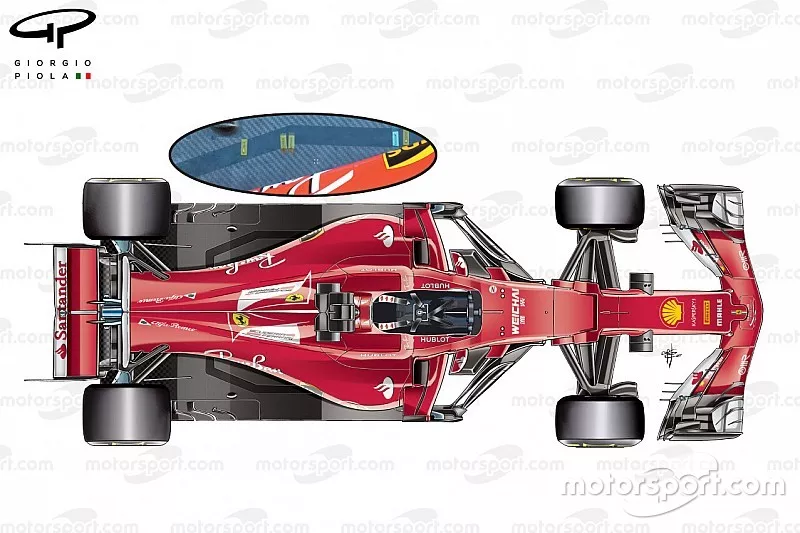
Ferrari SF70H top view, undertray sensors detailed
Photo by: Giorgio Piola
What became apparent during the course of testing, although it could be seen at the launch, was that Ferrari has decided to use the floor as a conduit for cooling the car.
A channel, much like the ones you would see on a circuit board, can be seen exiting and re-entering the sidepod along its midriff.
The appearance of thermal stickers on the floor at various intervals along the conduit piqued interest in what the Scuderia is trying to achieve and still remains a little mysterious.
Testing, testing 1,2,3..
Like the rest of the teams, Ferrari is eager to make sure that the designs it has come up with for 2017 correlate with the data shown in CFD and during wind tunnel testing.

Ferrari SF70H front wing detail
Photo by: Giorgio Piola
During the first test Ferrari mounted laser sensors on its front wing to check and assess the deflection that is pre-loaded into its wing design.
One sensor was mounted over the central neutral section of the wing to measure the height that the wing is running at, while two more can be found at either end to check the deflection of the endplates and foot plates which can improve downforce.
As we know, teams pushed the deflection of front wings for a number of years but the FIA pushed back, making changes to the load tests.
However, with the wings widened for 2017 there is a little more scope to deflect the front wing should the FIA not make changes to its tests and Ferrari, among others, will be looking to exploit this.

Sebastian Vettel, Ferrari SF70H
Photo by: Giorgio Piola
During the first day of the second test the team has installed cameras and lights on the front edge of the floor, looking forward.
These are being used to investigate how Pirelli's rubber deforms under load so the team can study and understand how to make changes to this area of the car to improve performance as the season unfolds.
We want your opinion!
What would you like to see on Motorsport.com?
Take our 5 minute survey.
- The Motorsport.com Team
Read and post comments
Read also :
Share Or Save This Story
Copy link
Share on Viber
Previous article F1 2017 cars not ‘easy’ for rookies like Stroll
Next article McLaren says F1 car handling issues are "fake news"
Top Comments
There are no comments at the moment. Would you like to write one?
View More & Comment

More from
Matt Somerfield

Gallery: How F1 tech evolved during the 2024 season
Formula 1
Formula 1 Dec 31, 2024
Gallery: How F1 tech evolved during the 2024 season
How McLaren’s rear wing push changed the game in F1
Formula 1
Formula 1 Dec 20, 2024
How McLaren’s rear wing push changed the game in F1
How 2026 F1 rules will help avoid identikit designs
Formula 1
Formula 1 Dec 16, 2024
How 2026 F1 rules will help avoid identikit designs
More from
Ferrari
“We lost one second down the straight” – Charles Leclerc upset with Ferrari’s “crazy” Las Vegas deficiency
Formula 1
Formula 1
Las Vegas GP
1 h
“We lost one second down the straight” – Charles Leclerc upset with Ferrari’s “crazy” Las Vegas deficiency
Lewis Hamilton reveals Ferrari F1 car damage after Las Vegas Q2 exit
Formula 1
Formula 1
Las Vegas GP
2 h
Lewis Hamilton reveals Ferrari F1 car damage after Las Vegas Q2 exit
Top 10 F1 cars of the 1980s
Formula 1
Top 10 F1 cars of the 1980s
Latest news

How Marc Marquez can be crowned MotoGP champion in Portuguese GP sprint
MotoGP
MGP MotoGP
Portuguese GP
22 min
How Marc Marquez can be crowned MotoGP champion in Portuguese GP sprint
Macau GP: Rashid Al Dhaheri defeats Mattia Colnaghi to take qualification race win
Other open wheel
Misc Other open wheel 28 min
Macau GP: Rashid Al Dhaheri defeats Mattia Colnaghi to take qualification race win
Max Verstappen reveals mysterious Red Bull issue that cannot be fixed in Las Vegas
Formula 1
F1 Formula 1
Las Vegas GP
42 min
Max Verstappen reveals mysterious Red Bull issue that cannot be fixed in Las Vegas
Lando Norris frustrated by McLaren's "shocking" top speed at Las Vegas GP qualifying
Formula 1
F1 Formula 1
Las Vegas GP
1 h
Lando Norris frustrated by McLaren's "shocking" top speed at Las Vegas GP qualifying
Feature
Discover prime content

Top 10 F1 cars of the 1980s
Formula 1
By Kevin Turner
Top 10 F1 cars of the 1980s
Subscribe and access Motorsport.com with your ad-blocker.
From Formula 1 to MotoGP we report straight from the paddock because we love our sport, just like you. In order to keep delivering our expert journalism, our website uses advertising. Still, we want to give you the opportunity to enjoy an ad-free and tracker-free website and to continue using your adblocker.
You have 2 options:
- Become a subscriber.
- Disable your adblocker.
Subscribe now Already subscribed? Sign in here
Already disabled your adblocker?
Reload page
Manage Alerts
Subscribe