Formula 1
The fascinating insight from those who examined Senna's crash wreckage
Thirty-one years on, the events of the 1994 San Marino Grand Prix weekend still have the power to shock. This extract from the book Senna: The Truths features insight from experts whose testimony was heard in the Italian criminal trial that followed
Franco Nugnes
Edited: May 1, 2025, 12:12 PM
Copy link
Share on Viber
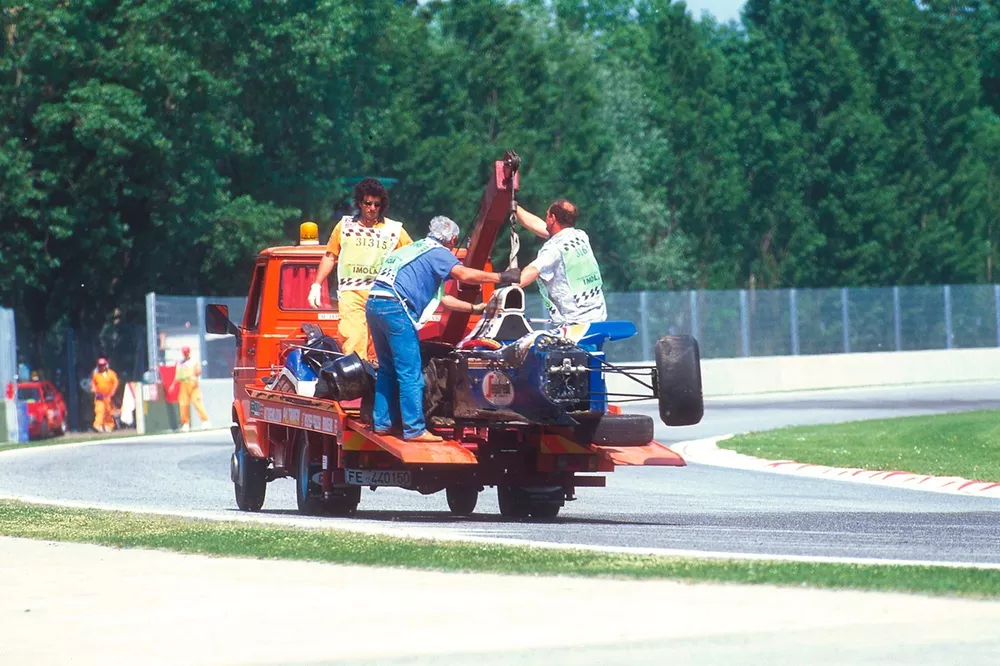
It is a quirk of Italian law that, if a fatality occurs, even on a race track, someone must be held responsible. The tragic deaths of Roland Ratzenberger and Ayrton Senna during the 1994 San Marino Grand Prix weekend resonated through the world and put Formula 1 under intense scrutiny.
While Ratzenberger’s accident was clearly caused by front-wing failure, Senna’s became the object of frenzied speculation. As the FIA sought to find lessons from the fatalities that could be translated into effective safety improvements, the Italian legal machine swung into action and a criminal trial ensued.
Public prosecutor Maurizio Passerini’s case focused on establishing that a shear in the steering column of Senna’s FW16 caused him to spear off the circuit at the Tamburello corner and into the wall. Passerini appointed Professor Enrico Lorenzini, Dean of the Faculty of Engineering at the University of Bologna, as an expert.
Lorenzini ordered the column to be analysed by two teams of specialists from different institutions so the results could be compared and correlated.
One part of the investigation was entrusted to the Air Force’s Research and Experimentation Division, based in Pratica di Mare, near Lazio, and the other to the Metallurgy Laboratory of Industrial Chemistry at the University of Bologna. Both teams used a SEM – Scanning Electron Microscope – the most advanced tool of the time.
Thirty years later, Motorsport.com managed to contact Gian Paolo Cammarota and Angelo Casagrande, the two professors from the University of Bologna who performed the analyses. They have remained friends and still occasionally see each other.
Cammarota and Casagrande give their thoughts on what happened that fateful day
Photo by: Motorsport Images
Cammarota, born in 1936 in Milan, now retired, divides his time between Bologna, Venice, and Germany. A slender, reserved man, he weighs every word carefully.
While Cammarota’s speciality was Industrial Chemistry, Casagrande, a Bolognese, is still part of the teaching staff in the Faculty of Metallurgy.
“We’re phasing out the SEM now – more modern and advanced investigative systems exist – but the scanning electron microscope gave us clear, indisputable answers in the Senna case,” says Casagrande.
In the original design of the Williams FW16, the steering column was a single-piece metal tube measuring 910.2mm in length, from the connection with the steering box to the steering wheel hub. At a distance of 685.5mm from the lower end (steering box), the column was attached to the chassis via an aluminium alloy support with a self-lubricating bushing made of Teflon-like material, leaving the remaining portion – 224.7mm long – as a cantilever.
Senna complained to the team of being uncomfortable in the cockpit: he wanted the steering column to be lowered, to improve his driving position because, when using his preferred steering wheel design his knuckles rubbed against the top of the chassis, with painful results. It wasn’t a simple task because regulations required that, once the steering wheel was removed, there had to be enough clearance in the cockpit section for a 250mm x 250mm template to pass through, as per the 1994 FIA rules.
To accommodate Senna’s wishes, Adrian Newey – then Williams’ chief designer – directed the drawing office to lower the steering column by 2mm. When this was found to snag the FIA template, the next best solution was to reduce the diameter of the column by 4mm in that area.
“Reducing the diameter of the tube was a major design mistake,” Cammarota says. “The chemical and mechanical property analyses of the parts weren’t consistent – they clearly showed the use of two different materials.”
The modified column was divided into three parts, two made of T45 steel, with external diameters of 22.225mm and a wall thickness of 0.9mm, with an intermediate section of EN14 steel 18mm in external diameter and a wall thickness of 1.2mm. These parts were welded together.
Senna was uncomfortable in his FW16, so modifications were made
Photo by: Motorsport Images
Franco Nugnes: What tests did you perform?
Gian Paolo Cammarota: We carried out a superficial metallographic analysis, then internal and external roughness tests, and a fractographic examination. The chemical analysis was entrusted to Cermet.
In the expert report submitted to the court by Professor Lorenzini, it reads: ‘In general terms, it must be said that the three-piece steering column is indicative of a poorly designed modification, as the thinness of the section precisely at the point of maximum stress, the abrupt change in cross-section with an excessively small fillet radius, and the scratches caused by the mechanical processes of drilling and turning all contribute to creating a structurally critical situation, with a consequent high risk of failure under static loads and dynamic fatigue.
‘Incidentally, on the external and internal surfaces of the joint, immediately below the fracture surface, pronounced circumferential marks from machining tools can be observed, so the external and internal surfaces of the tube exhibit a surface finish unsuitable for components operating under fatigue in extreme experimental conditions.’
FN: Could human error have occurred during welding?
GPC: I rule that out. I showed our images to Professor Horst Herold from the University of Magdeburg, a leading expert in the field, and he assured me that the welds were perfect. The problem lay entirely in the reduction of the tube’s cross-section precisely at the point where the stress was at its maximum.
FN: So why did the steering column fail?
Angelo Casagrande: It was already damaged before the start of the grand prix. In short, there was a crack [in metallurgy, a thin and often deep fissure that precedes a break] that was progressing and had formed before the race in which Senna lost his life. The presence of oxidation didn’t allow us to determine exactly when the fatigue phenomenon began, but it was enough for us to understand what had happened.
FN: In Formula 1, the best materials available are usually chosen – what could have gone wrong?
AC: They made an unplanned modification. The dimensions of the shaft and the cantilever section were such that, even with a super-material, it might have lasted one more race at best. Then it would have failed if not replaced, because it couldn’t withstand the stresses. There’s no point blaming the material: that was an aggravating factor but, given the dimensions and the structural characteristics of the component, that metal couldn’t have done much better.
The engineering experts spent a week examining the remains of Senna's car
Photo by: Rainer W. Schlegelmilch / Motorsport Images
FN: How long did you have the steering column for?
GPC: Less than a week, then we returned it. Just enough time to perform the SEM exams. Engineer Danesi was always present during the analysis, representing Williams.
At first, the British team didn’t want to hear anything about fatigue, but we immediately saw the failure and had to assess how much of the tube had broken due to fatigue and how much due to tearing.
FN: The investigation also included roughness tests...
GPC: Roughness is the ratio between the base of a groove and the surface. If the value is high, you risk serious trouble.
In aerospace, all surfaces must be polished to a mirror finish. There must be no striations that can concentrate stress and become the starting point for surface alterations when the fatigue threshold of the material is exceeded.
On our column, there was only partial polishing on the outside – it should have been mirror-finished – and inside, nothing had been done at all. The crack definitely started from the inside, probably already during practice.
There were three sections in the tube: one showed fatigue; the middle section showed a mix of fatigue and ductile fracture, which is to be expected when the material is very tough; and in the third, the final section, there was clear evidence of a catastrophic fracture caused by the impact with the wall.
FN: The team had removed layers of carbonfibre and cut part of the chassis covering. Did these interventions reduce the stiffness of the monocoque, and could they have contributed to initiating the steering column fractures?
GPC: It’s possible, but this issue wasn’t addressed in the trial. There may have been an acceleration in the crack’s propagation – we would need to know precisely when the crack began.
--
Newey's role was examined in the trial
Photo by: Rainer W. Schlegelmilch / Motorsport Images
The criminal trial was wide-ranging, accusing Frank Williams, Patrick Head and Adrian Newey of manslaughter, and FIA official Roland Bruynseraede, race organiser Federico Bendinelli and Imola track manager Giorgio Poggi of culpable homicide. As it progressed, Passerini moved to drop the charges against Williams, Bruynseraede, Bendinelli and Poggi, focusing his attentions on Head and Newey.
Once it had possession of the steering column and recognised the fatigue crack, Williams built a test rig to establish whether the column was strong enough to transmit steering inputs at the required torque for normal driving even in a weakened state. Its findings suggested this was the case.
The TV footage clearly showed the rear end of Senna’s car stepping out just before his car left the track, which wasn’t consistent with the prosecution’s argument that the steering had failed and caused the car to go straight on. It was impossible to prove whether the failure was the cause or effect of the accident – so, rightly, Head and Newey were acquitted and a subsequent attempt to appeal the decision failed.
The lessons of Imola not only informed the FIA’s ongoing safety project, they affected the process of car design. Williams, for example, brought in a system whereby safety-critical components could be signed off for production only after the designs had been counter-signed by an experienced stress engineer.
“Regardless of whether that steering column caused the accident or not,” wrote Newey in his autobiography, “there is no escaping the fact that it was a bad piece of design that should never have been allowed to get on the car.”
We want your opinion!
What would you like to see on Motorsport.com?
Take our 5 minute survey.
- The Motorsport.com Team
Read and post comments
Read also :
Share Or Save This Story
Copy link
Share on Viber
Previous article Ferrari’s Miami GP livery reveal falls flat with fans
Next article F1 Panel: Is Yuki Tsunoda doing enough to prove Red Bull right?
Top Comments
There are no comments at the moment. Would you like to write one?
View More & Comment
More from
Franco Nugnes
Aston Martin braces for Australian GP pain amid Honda F1 crisis
Formula 1
Formula 1
Australian GP
8 mo
Aston Martin braces for Australian GP pain amid Honda F1 crisis
Alpine's innovative 2026 F1 rear wing explained
Formula 1
Formula 1
Barcelona-Catalunya Pre-Season Testing
9 mo
Alpine's innovative 2026 F1 rear wing explained

Gianpiero Lambiase in talks to leave Red Bull for Williams or Aston Martin
Formula 1
Formula 1 10 mo
Gianpiero Lambiase in talks to leave Red Bull for Williams or Aston Martin
More from
Ayrton Senna
‘Kimi Antonelli isn’t Ayrton Senna yet, but he may be a Senninha’ – Toto Wolff
Formula 1
Formula 1
Sao Paulo GP
2 d
‘Kimi Antonelli isn’t Ayrton Senna yet, but he may be a Senninha’ – Toto Wolff
Who belongs on F1's Mount Rushmore? Pick your four greatest drivers
Formula 1
Formula 1 2 mo
Who belongs on F1's Mount Rushmore? Pick your four greatest drivers
Top 10 F1 drivers of the 1980s
Formula 1
Top 10 F1 drivers of the 1980s

More from
Williams
"It's horribly painful" - Williams drops 2026 car upgrades to benefit 2027
Formula 1
Formula 1
Sao Paulo GP
1 h
"It's horribly painful" - Williams drops 2026 car upgrades to benefit 2027
What the Brazilian GP revealed about F1's ability to cope with rain
Formula 1
Formula 1
Sao Paulo GP
2 d
What the Brazilian GP revealed about F1's ability to cope with rain
Latest news
Sebastien Bourdais hopes latest WEC success will remind teams of his value
WEC
WEC WEC
Monza
47 min
Sebastien Bourdais hopes latest WEC success will remind teams of his value
"It's horribly painful" - Williams drops 2026 car upgrades to benefit 2027
Formula 1
F1 Formula 1
Sao Paulo GP
1 h
"It's horribly painful" - Williams drops 2026 car upgrades to benefit 2027
Iker Lecuona felt significant differences between Ducati's GP25 and GP26
MotoGP
MGP MotoGP
Qatar GP
3 h
Iker Lecuona felt significant differences between Ducati's GP25 and GP26
Feature
Discover prime content
Top 10 F1 cars of the 1970s
Formula 1
By Kevin Turner
Top 10 F1 cars of the 1970s

Subscribe and access Motorsport.com with your ad-blocker.
From Formula 1 to MotoGP we report straight from the paddock because we love our sport, just like you. In order to keep delivering our expert journalism, our website uses advertising. Still, we want to give you the opportunity to enjoy an ad-free and tracker-free website and to continue using your adblocker.
You have 2 options:
- Become a subscriber.
- Disable your adblocker.
Subscribe now Already subscribed? Sign in here
Already disabled your adblocker?
Reload page
Manage Alerts
Subscribe