Formula 1
How long is an F1 race? Laps, time, distance and more explained
Each Formula 1 grand prix is different with some lasting longer than others, but why is that and what rules does the championship have its races?

Ed Hardy
Edited: Feb 6, 2024, 2:27 AM
Copy link
Share on Viber
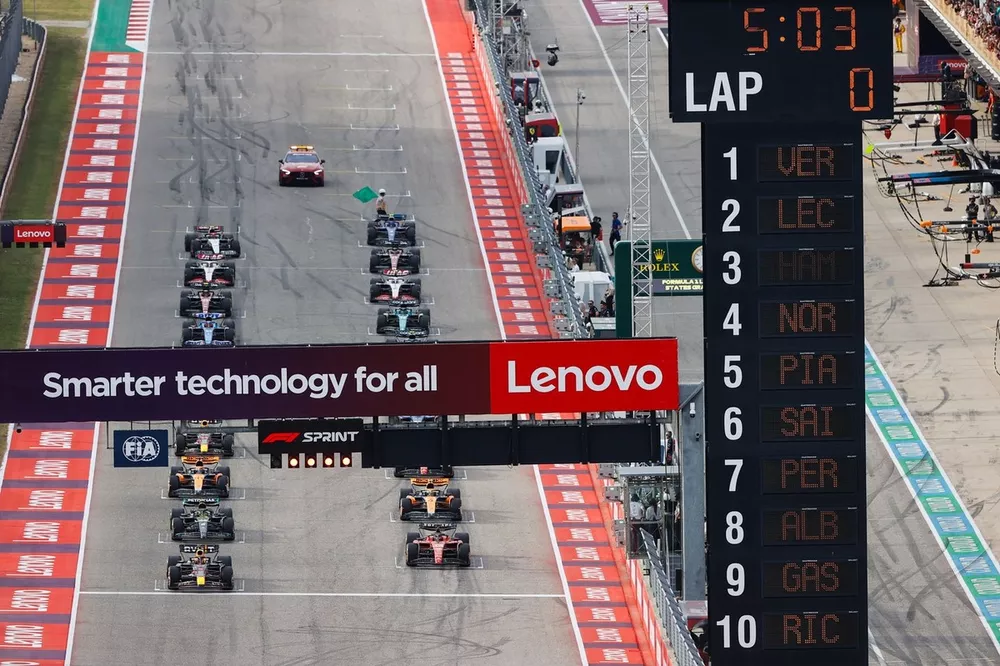
Formula 1 fans will notice that every grand prix lasts both a different number of laps and length of time, which makes it unlike some other motor racing categories in the world.
This is because the series runs to a specific distance rather than amount of time – like the Le Mans 24 Hours, 12 Hours of Sebring and more – due to the various circuits its calendar holds. This is to ensure every race is roughly the same length, because 70 laps around Silverstone could take double that of 70 laps in Montreal.
So instead of a clock in the corner of the live feed, it is a lap count to tell fans how close the race is to finishing.
Many different factors therefore contribute to how long an F1 grand prix is as some have taken close to five hours to finish while others are done in just over 60 minutes. So here is everything to know about the rules around race length, controversy that has happened over the years and more.
F1 race weekend format
Before knowing about how long an F1 grand prix is, it is important to first be clear about the weekend’s format and what comes before the race.
For a traditional weekend the series starts with two, one-hour practice sessions on a Friday. It gives teams a good chance to run different car set-ups, complete testing programmes, try out upgrades and if it is a new track – like Las Vegas in 2023 – then Friday is an opportunity to learn more about the circuit.
There is then a third and final practice session on Saturday and that is an opportunity for teams to start testing their one-lap pace ahead of qualifying later in the day, which determines the grid for Sunday’s grand prix.
However, 2021 saw the introduction of the sprint race format. This happens on select weekends in the year and over 2023 there were six: Austin, Austria, Azerbaijan, Belgium, Brazil and Qatar. This was brought in as an alternative to the traditional weekend, as there is racing on Saturday and Sunday.
So on a 2023 sprint weekend, a practice sessions begins things on Friday but that is the only practice session of the weekend. What follows on Friday is qualifying for Sunday’s grand prix, with sprint qualifying and then the sprint race on Saturday.
How many laps are there in an F1 race?
Every F1 race has a different number of laps because the minimum length of a grand prix is 190 miles (305 kilometres) so they are given the scheduled number of tours it takes to approximately reach that mark.
This means grands prix on smaller tracks have more laps than those on bigger ones – for example Zandvoort is only 2.6 miles (4.259km) in length which is almost half that of Spa-Francorchamps. As a result, the Dutch Grand Prix is 72 laps while the Belgian GP is just 44, yet drivers complete the same race distance at both events.
However, there is an exception to this rule and that is Monaco whose minimum race distance is 160 miles (257km). While it is the calendar’s smallest circuit at just over two miles (3.337km), it is also a slow lap as Max Verstappen’s average speed when he won the 2021 race was 98mph compared to 179mph for his victory in Bahrain, which also had a safety car and therefore impacted the overall total.
This meant several years ago when F1 cars were slower than they are today, it was tough to complete 190 miles around Monaco while operating to the two-hour time limit grands prix are given.
Monaco also has the most number of laps (78) of any circuit, yet drivers are still only completing 160 miles which further highlights why it needs to run to a lower minimum distance.
Sprint races are now a factor as well. This is a 62-mile (99.8km) dash which essentially makes it a shortened version of the Sunday race, with approximately a third of the points being awarded.
Just like the grand prix, sprint races can vary in the number of laps depending on the circuit. There were just 11 for the sprint race at Spa in 2023, as opposed to 24 laps at the Red Bull Ring with Baku (17), Circuit of the Americas (19), Losail (19) and Interlagos (24) differing as well.
Scheduled distance of every F1 grand prix in 2024
Round
Race
Circuit
Laps
Circuit length
Race distance
1
Bahrain GP
Bahrain International Circuit
57
3.363 miles
190.253 miles
2
Saudi Arabian GP
Jeddah Corniche Circuit
50
3.836 miles
191.662 miles
3
Australian GP
Albert Park Circuit
58
3.280 miles
190.217 miles
4
Japanese GP
Suzuka
53
3.608 miles
191.054 miles
5
Chinese GP
Shanghai International Circuit
56
3.387 miles
189.7 miles
6
Miami GP
Miami International Autodrome
57
3.363 miles
191.584 miles
7
Emilia Romagna GP
Autodromo Enzo e Dino Ferrari
63
3.050 miles
192.034 miles
8
Monaco GP
Circuit de Monte Carlo
78
2.074 miles
161.772 miles
9
Canadian GP
Circuit Gilles Villeneuve
70
2.710 miles
189.686 miles
10
Spanish GP
Circuit de Barcelona-Catalunya
66
2.894 miles
190.908 miles
11
Austrian GP
Red Bull Ring
71
2.683 miles
190.420 miles
12
British GP
Silverstone Circuit
52
3.660 miles
190.263 miles
13
Hungarian GP
Hungaroring
70
2.722 miles
190.531 miles
14
Belgian GP
Spa-Francorchamps
44
4.352 miles
191.415 miles
15
Dutch GP
Circuit Zandvoort
72
2.646 miles
190.504 miles
16
Italian GP
Monza Circuit
53
3.599 miles
190.586 miles
17
Azerbaijan GP
Baku City Circuit
51
3.730 miles
190.170 miles
18
Singapore GP
Marina Bay Street Circuit
62
3.070 miles
190.228 miles
19
United States GP
Circuit of the Americas
56
3.426 miles
191.634 miles
20
Mexico GP
Autodromo Hermanos Rodriguez
71
2.674 miles
189.738 miles
21
Brazilian GP
Interlagos
71
2.677 miles
190.064 miles
22
Las Vegas GP
Las Vegas Strip Circuit
50
3.853 miles
192.599 miles
23
Qatar GP
Losail International Circuit
57
3.367 miles
191.762 miles
24
Abu Dhabi GP
Yas Marina Circuit
58
3.281 miles
190.253 miles
How long does an F1 race take?
Although each race has a scheduled number of laps, it is still against a clock to get the full distance done.
That is because F1 has two hours to complete the scheduled distance from lights out, but for differing factors whether it be multiple safety cars, slow laps etc, sometimes it cannot be completed within the time limit. Therefore, if a race hits two hours then the grand prix finishes at the end of the next full lap regardless of how many tours have been completed.
Photo by: Patrick Vinet / Motorsport Images
A marshal waves the red flag
In addition, that two hours is only given for track time yet the race might come to a halt because of a red flag. Therefore, in case of such F1 has a three-hour window to get two hours of track time completed from the moment the grand prix has officially begun.
But usually, races reach the scheduled distance without coming close to the time limit. As seen below, the grands prix in 2023 have approximately taken 90 minutes for the race winner to take the chequered flag.
*Total time includes any stoppages
2023 grand prix
Time taken for race winner to cross the line
Bahrain GP
1h33m56.736s
Saudi Arabian GP
1h21m14.894s
Australian GP
2h32m38.371s
Azerbaijan GP
1h32m42.436s
Miami GP
1h27m38.241s
Monaco GP
1h48m51.980s
Spanish GP
1h27m57.940s
Canadian GP
1h33m58.348s
Austrian GP
1h25m33.607s
British GP
1h25m16.938s
Hungarian GP
1h38m08.634s
Belgian GP
1h22m30.450s
Dutch GP
2h24m04.411s
Italian GP
1h13m41.143s
Singapore GP
1h46m37.418s
Japanese GP
1h30m58.421s
Qatar GP
1h27m39.168s
United States GP
1h35m21.362s
Mexico GP
2h02m30.814s
Brazilian GP
1h56m48.894s
Las Vegas GP
1h29m08.289s
Abu Dhabi GP
1h27m02.624s
Of course, sprint races do not take as long to complete. On average, they are around one hour shorter than the grand prix with Verstappen taking the Austrian sprint race chequered flag in 30m26.730s.
Photo by: Jake Grant / Motorsport Images
Max Verstappen, Red Bull Racing RB19, 1st position, leads Sir Lewis Hamilton, Mercedes F1 W14, 2nd position, as the chequered flag is waved
What happens if an F1 race is unable to complete all of its scheduled laps?
Sometimes when the three-hour window comes to an end, the grand prix itself has completed very few laps – usually because of multiple safety car interventions or red flags – and in cases like that, full points may not be awarded.
As of 2022, points can only be given once the leader has completed at least two racing laps without a safety car or virtual safety car being deployed. So, let’s say the race leader has done three laps uninterrupted but no more than 25% of the scheduled distance, then approximately one quarter of points will be awarded which gradually increases as per the table below.
Position
Two laps or fewer
Up to 25% race distance
26-50% race distance
51-75% race distance
Over 75% race distance
1
0 points
6 points
13 points
19 points
25 points
2
0 points
4 points
10 points
14 points
18 points
3
0 points
3 points
8 points
12 points
15 points
4
0 points
2 points
6 points
9 points
12 points
5
0 points
1 point
5 points
8 points
10 points
6
0 points
0 points
4 points
6 points
8 points
7
0 points
0 points
3 points
5 points
6 points
8
0 points
0 points
2 points
3 points
4 points
9
0 points
0 points
1 point
2 points
2 points
10
0 points
0 points
0 points
1 point
1 point
This rule was implemented after the controversial, rain-hit 2021 Belgian GP which was simply a two-lap procession behind the safety car as conditions were deemed unsafe to race in. Despite no actual racing laps being completed under green flag conditions, all F1 needed at the time was at least two tours behind a safety car for half points to be awarded.
It put the series under the cosh because some accused F1 of just trying to get to that two-lap minimum before awarding points, instead of finding other alternatives so that fans could actually watch some racing. It was therefore hard for some to call it a ‘race’, despite a significant chunk of points being awarded.
Photo by: Rainer W. Schlegelmilch / Motorsport Images
The cars underneath marquees during the red flag period
What is the longest race in F1 history?
The famous 2011 Canadian GP holds the record for being the longest F1 race in history at 4h04m39.537s. That day Montreal was hit by heavy rainfall and it was that bad the race had to start under a safety car.
Green flag conditions did not arrive until five laps in where Sebastian Vettel led the grand prix but Lewis Hamilton and Mark Webber collided at Turn 1 in their battle for fourth. It cost both drivers several positions and on lap seven when attempting to climb back up the order, Hamilton was put into the pitwall by then McLaren team-mate Jenson Button as visibility proved tough, and the 2009 world champion could not see him coming through.
This caused another safety car period and Button used it as an opportunity to switch to intermediate tyres with conditions improving. But it was not so simple for the McLaren driver as he was first given a drive-through penalty for speeding behind the safety car, before heavier rain soon fell meaning he had to switch back to full wets.
The rain became harder and by lap 19 another safety car period was called, before the grand prix got red-flagged six tours later because of the conditions. It was then suspended for just over two hours until the weather began to improve again.
Another safety car period led the first eight laps after the restart, but green flag conditions only lasted one tour. This is because the safety car was once again required as Fernando Alonso collided with Button at Turn 3 which left a puncture on the McLaren but the Ferrari car in the wall.
Button therefore pitted and was down in 21st when the race restarted three tours later on lap 40. But upon the restart, Button with his fresher tyres coped with the conditions much better than others as he rapidly progressed through the order and was 14th by lap 44.
From this point on the race was uninterrupted and Button ultimately claimed the most unlikely of victories, after Vettel ran wide at Turn 6 on the final lap to give the McLaren driver the race lead. Button subsequently took the chequered flag after a record six safety car periods and a red flag interval.
The 2011 Canadian GP also belongs to the list of F1 records that will never be broken. In the aftermath, F1 introduced a four-hour time limit for grands prix to be completed - later reduced to three for 2021 - meaning no race can exceed that of Montreal in 2011.
Photo by: Erik Junius
The 2021 Belgian GP is F1's shortest ever race
What is the shortest race in F1 history?
The 2021 Belgian GP holds the record for the shortest F1 race in history at 3m27.071s, which caused Hamilton to say fans were “robbed” of a grand prix.
After over three hours of delays and suspended starts, the safety car finally led drivers out of the pitlane which officially commenced the race. Two laps were completed behind the safety car before the race got suspended during a third lap and not to be resumed, which handed victory to Verstappen.
Read Also:
Formula 1F1 prize money: How much teams earned in the 2023 season
Formula 1F1 safety car: What is it and how does it work?
Formula 12024 F1 season driver line-up and calendar: Everything you need to know
We want your opinion!
What would you like to see on Motorsport.com?
Take our 5 minute survey.
- The Motorsport.com Team
Read and post comments
Read also :
Share Or Save This Story
Copy link
Share on Viber
Previous article F1 champion Verstappen: 'Alonso only wants to return to Le Mans if it's with me'
Next article Alonso: 2023 my best F1 season alongside 2012 Ferrari title miss
Top Comments
There are no comments at the moment. Would you like to write one?
View More & Comment

More from
Ed Hardy
George Russell launches karting academy
Formula 1
Formula 1
Sao Paulo GP
1 d
George Russell launches karting academy
Formula E postpones Jeddah E-Prix with Mexico now the season opener
Formula E
Formula E 1 d
Formula E postpones Jeddah E-Prix with Mexico now the season opener
Latest news
Sebastien Bourdais hopes latest WEC success will remind teams of his value
WEC
WEC WEC
Monza
Sebastien Bourdais hopes latest WEC success will remind teams of his value
"It's horribly painful" - Williams drops 2026 car upgrades to benefit 2027
Formula 1
F1 Formula 1
Sao Paulo GP
1 h
"It's horribly painful" - Williams drops 2026 car upgrades to benefit 2027
Iker Lecuona felt significant differences between Ducati's GP25 and GP26
MotoGP
MGP MotoGP
Qatar GP
2 h
Iker Lecuona felt significant differences between Ducati's GP25 and GP26
Feature
Discover prime content
Top 10 F1 cars of the 1970s
Formula 1
By Kevin Turner
Top 10 F1 cars of the 1970s

Subscribe and access Motorsport.com with your ad-blocker.
From Formula 1 to MotoGP we report straight from the paddock because we love our sport, just like you. In order to keep delivering our expert journalism, our website uses advertising. Still, we want to give you the opportunity to enjoy an ad-free and tracker-free website and to continue using your adblocker.
You have 2 options:
- Become a subscriber.
- Disable your adblocker.
Subscribe now Already subscribed? Sign in here
Already disabled your adblocker?
Reload page
Manage Alerts
Subscribe