Formula 1
How Hamilton passed Vettel and other inside stories from Mercedes engine HQ
Mercedes has been the top scoring F1 engine maker since it started selling customer engines in 2009, with 35 wins and 104 podiums.
Published: Dec 6, 2011, 5:32 PM
Copy link
Share on Viber

Motorsport Blog
Motorsport Blog
Mercedes has been the top scoring F1 engine maker since it started selling customer engines in 2009, with 35 wins and 104 podiums.
The Mercedes AMG powertrain division at Brixworth in Northampton opened its doors today to a small group of media to give us a behind the scenes insight into what went on during 2011 and to get a sneak peak of how the 2014 engine is coming on, which I will post on separately.
We learned some very interesting background information from senior Mercedes engineer Andy Cowell about some of the things engine builders faced in 2011.
In terms of the best way of managing engine rotation with 8 units having to last 19 races, it was interesting to see that their highest use engine did a total of 3,073 kilometres, which included three of the early season races as well as six Friday practice sessions. Teams always plan to use a new engine for Turkey, Spa and Monza in particular and these units would probably not do a third race.
It’s amazing to look back on the days when each team would bring as many as 10 engines to each race and bolt in a fresh one every day. What has come with the freeze in V8 engine regulations is a deeper understanding of the engines, which has brought amazing reliability The ceramic pistons today, for example, are lighter than those on qualifying engines of 10 years ago when they were just about strong enough to last for an hour’s qualifying session. And yet now they last 3,000kms!
Another challenge this year was dealing with simultaneous KERS and DRS deployment without hitting the rev limiter on the straights. This was done through gearing, of course, because interestingly simultaneous deployment of DRS and KERS adds an extra 1,000 revs at the end of the straight and you don’t want to hit the rev limiter because that adds 15-20% more engine stress.
We also looked at the exhaust blown diffusers, which have now been banned from 2012 onwards. Cowell showed us the telemetry graphs of a typical corner where you can see that as the driver lifts off the accelerator pedal, the throttles stay wide open, the torque is cut by retarding the ignition and the exhaust gas pressure blowing out across the diffuser is way higher than it would be on the normal overrun. The temperature of the exhaust gas is also way higher by 200 degrees. This must have been very costly in exhaust materials.
What was interesting was the subtleties with the EBD; with certain engine modes the driver could use the throttle in special ways and have an effect on the downforce in corners as a result and Cowell confirmed that this was an area where Vettel had made gains in key moments, typically the final run in qualifying.
We then looked at KERS, which is very much still part of the rules for 2012, although it will be evolved in 2014 to ERS, which will harvest far more energy from different sources and provide double the power back to the engine.
This was where you realise what a wasted opportunity KERS is as a story in F1, as we looked in detail at the way Lewis Hamilton used it to pass Sebastian Vettel in China. Hamilton deployed the KERS button for a good long burst in a place where you would never do it if you were looking for lap time; Turns 6 and 7 and yet he did so because he knew it could give him the surge he needed to get alongside Vettel on the inside for the left hander. And so it proved.
Another example looked at a defensive strategy, with Hamilton using KERS on the straight in Korea to fight off a DRS-boosted attack from Mark Webber. Clearly these were some of the areas of racing where the superior KERS worked for Mercedes’ teams
Mercedes provides exactly the same engine and KERS unit to all three of its teams; Mercedes AMG, McLaren and Sahara Force India and the benefit worked out on average at around 0.4secs per lap across the calendar with some circuits like Monza more of a gain than others.
The only difference between the engines is some of the wiring from the KERS, dependent on chassis design. This year Mercedes got its unit down to just 24 kilos and increased the efficiency to 80%, which means that they needed to harvest 500 kjoules of energy to inject 400 kjoules back in. The KERS processes 400 kjoules per second.
We looked at an engine on the dyno, which was running some development parts for 2012 and even a few ideas for the 2014 engine.
It stuck me that in a heavily testing restricted modern F1 world, engines are really the only area where testing goes on all the time. Whereas each of their teams will do around 50,000 kilometres on track each season, so 150,000 kilometres in total - Mercedes will do that much again in dyno testing.
Each one of a driver’s 8 new engines is given a shakedown test on the dyno for 150 kilometres before going off the race track to be fitted into a car.
We also learned from the Petronas engineers how they support Mercedes on the fuel and lubes side with the works team and the gains coming from fuel in particular. It sounds like there is a lot more to come from this area.

At races, Mercedes supplies each of its teams with 3 technicians, 3 engineers and 1 manager to provide track support. Some of them were on hand to show us the ropes when it came time to have a go at assembling a few parts of a V8 engine. We had to fit the fuel injectors, a heat shield and the exhausts. It’s a little hands on exercise, a bit of fun for guests.
Apparently Michael Schumacher - a keen karting mechanic - did the challenge in under 3 minutes. I took considerably longer as I failed to notice that one of the manifolds had moved and had to undo half the nuts and start again...
We want your opinion!
What would you like to see on Motorsport.com?
Take our 5 minute survey.
- The Motorsport.com Team
Read and post comments
Read also :
Share Or Save This Story
Copy link
Share on Viber
Previous article Owner hints all change for 2012 Lotus lineup
Next article Five BBC presenters move to Sky F1 team
Top Comments
There are no comments at the moment. Would you like to write one?
View More & Comment

More from
Mercedes
Kimi Antonelli: Yo-yo racing to return at F1 Las Vegas GP
Formula 1
Formula 1
Las Vegas GP
18 h
Kimi Antonelli: Yo-yo racing to return at F1 Las Vegas GP

The Kimi Antonelli you don't know, told by those closest to him
Formula 1
Formula 1
Mexican GP
1 d
The Kimi Antonelli you don't know, told by those closest to him

Latest news

Nike joins F1 as apparel partner
Formula 1
F1 Formula 1
Las Vegas GP
3 min
Nike joins F1 as apparel partner

LIVE: F1 Las Vegas GP updates - FP1
Formula 1
F1 Formula 1
Las Vegas GP
24 min
LIVE: F1 Las Vegas GP updates - FP1
New WRC challenger set for public debut at Spa Rally
WRC
WRC WRC
Rally Saudi Arabia
2 h
New WRC challenger set for public debut at Spa Rally
FIA to introduce full-time F1 stewards from 2027 to improve consistency
Formula 1
F1 Formula 1
Las Vegas GP
3 h
FIA to introduce full-time F1 stewards from 2027 to improve consistency
Feature
Discover prime content
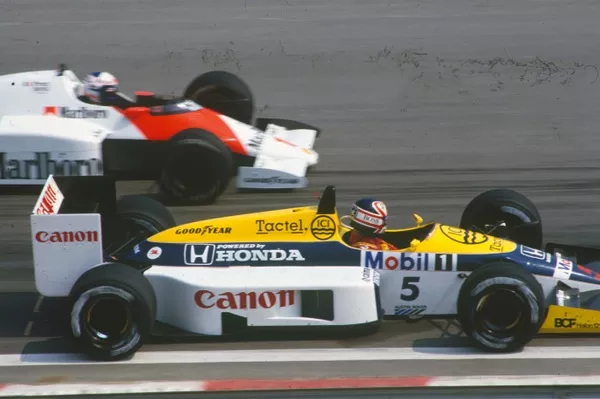
Top 10 F1 cars of the 1980s
Formula 1
By Kevin Turner
Top 10 F1 cars of the 1980s


Subscribe and access Motorsport.com with your ad-blocker.
From Formula 1 to MotoGP we report straight from the paddock because we love our sport, just like you. In order to keep delivering our expert journalism, our website uses advertising. Still, we want to give you the opportunity to enjoy an ad-free and tracker-free website and to continue using your adblocker.
You have 2 options:
- Become a subscriber.
- Disable your adblocker.
Subscribe now Already subscribed? Sign in here
Already disabled your adblocker?
Reload page
Manage Alerts
Subscribe