Analysis
Formula 1
The Monza F1 set-up choice that helped deliver McLaren’s win
McLaren ended a lengthy victory drought at Formula 1’s Italian Grand Prix, with Daniel Ricciardo and Lando Norris making brilliant use of their cars' strengths to bring home a 1-2.
Matt Somerfield Giorgio Piola
Edited: Sep 18, 2021, 3:02 PM
Copy link
Share on Viber
Giorgio Piola's F1 technical analysis
Giorgio Piola is the preeminent Formula 1 technical journalist. View our full selection of Giorgio's technical illustrative content
Key to being able to stave off the threat from its Red Bull and Mercedes rivals was some impressive straightline speed performance in the race.
It meant that efforts of Lewis Hamilton and Max Verstappen to get around the Papaya Orange cars proved ultimately fruitless as they could never get close enough by the braking zones.
The foundations for that straightline speed advantage was the way that McLaren set up its already aerodynamically efficient car for the low downforce Monza circuit.
For however much its pace was helped by the Mercedes power unit, top speed was boosted by a Monza specific low downforce arrangement.
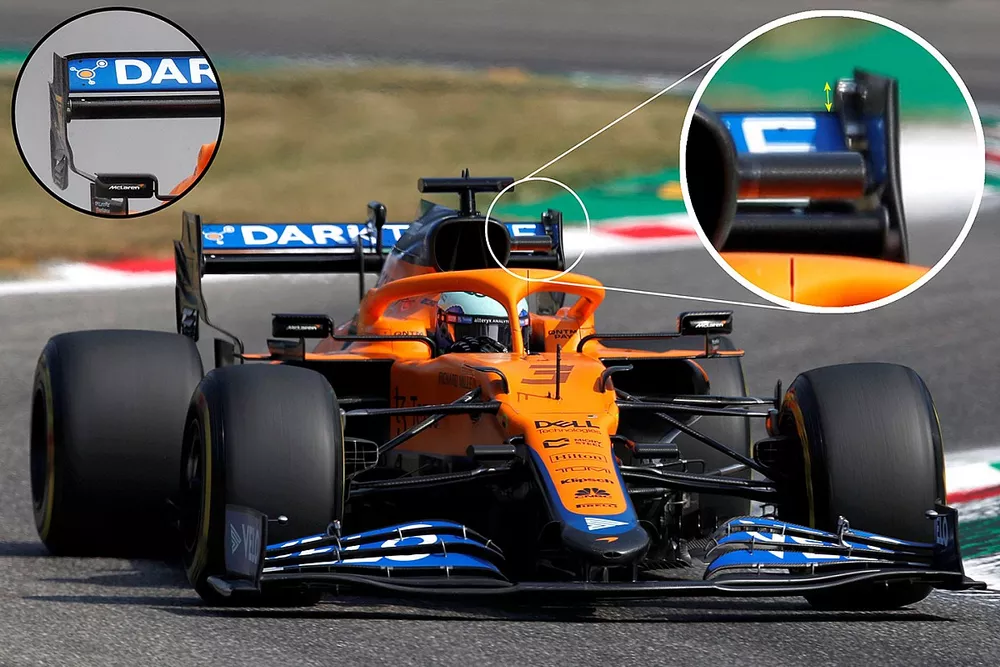
McLaren had utilized a spoon-shaped design for it low/mid downforce configuration at Baku and Silverstone, as well as a lower downforce design used at Spa.
This was trimmed out even further for Monza and followed a more conventional route.
As expected, the Monza-spec rear wing featured a much shallower angle of attack than the Spa configuration (inset, left), whilst the trailing edge of the top flap was also trimmed down so it sat inside the maximum tolerance permitted (inset, top right).
The Gurney flap found on the trailing edge of the top flap was also discarded in an effort to reduce drag further still.
McLaren MCL35M front wing detail
Photo by: Giorgio Piola
It’s a similar story at the front of the car too, as the team trimmed the front wing flap back quite significantly on the inboard end of the wing. This was in order to reduce the downforce being generated and help deliver a better aero balance front-to-rear.
The adjuster signals the point where the static outboard section of the wing ends and the moveable flapped section begins, and highlights the trend that F1 teams have followed for some years now.
The designers take this approach in order to compartmentalise the wing so that it provides the necessary downforce, whilst also creating sufficient outwash to reduce the impact that turbulence created by tyres has on the car downstream.
Read Also:
- Ricciardo: Monza F1 win was mine before Hamilton/Verstappen crash
- Horner: Verstappen "shouldn't have been near" Hamilton after pitstop drama
- FIA sees no need to change Monza kerbs after Verstappen/Hamilton clash
We want your opinion!
What would you like to see on Motorsport.com?
Take our 5 minute survey.
- The Motorsport.com Team
Read and post comments
Read also :
Share Or Save This Story
Copy link
Share on Viber
Previous article FIA sees no need to change Monza kerbs after Verstappen/Hamilton clash
Next article Having FP2 under F1's sprint format "makes no sense" - Todt
Top Comments
There are no comments at the moment. Would you like to write one?
View More & Comment

More from
Matt Somerfield

Gallery: How F1 tech evolved during the 2024 season
Formula 1
Formula 1 Dec 31, 2024
Gallery: How F1 tech evolved during the 2024 season
How McLaren’s rear wing push changed the game in F1
Formula 1
Formula 1 Dec 20, 2024
How McLaren’s rear wing push changed the game in F1
How 2026 F1 rules will help avoid identikit designs
Formula 1
Formula 1 Dec 16, 2024
How 2026 F1 rules will help avoid identikit designs

More from
McLaren
Five things to look out for at F1’s Qatar GP
Formula 1
Formula 1
Qatar GP
21 h
Five things to look out for at F1’s Qatar GP
Zak Brown rules out McLaren engine programme for F1 2030
Formula 1
Formula 1
Las Vegas GP
1 d
Zak Brown rules out McLaren engine programme for F1 2030
Top 10 F1 cars of the 1980s
Formula 1
Top 10 F1 cars of the 1980s
Latest news

Valencia circuit removes mural honouring Valentino Rossi - and replaces it with a giant screen
MotoGP
MGP MotoGP
Valencia GP
6 min
Valencia circuit removes mural honouring Valentino Rossi - and replaces it with a giant screen
The unexpected riding shift that took Marc Marquez to a 10th world title
MotoGP
MGP MotoGP 2 h
The unexpected riding shift that took Marc Marquez to a 10th world title
F1 2027 grid: Who will be racing and where? The full line-up
Formula 1
F1 Formula 1 2 h
F1 2027 grid: Who will be racing and where? The full line-up

Fernando Alonso to miss Qatar F1 media day with viral illness
Formula 1
F1 Formula 1
Qatar GP
3 h
Fernando Alonso to miss Qatar F1 media day with viral illness
Feature
Discover prime content
Top 10 F1 cars of the 1990s
Formula 1
By Kevin Turner
Top 10 F1 cars of the 1990s

Subscribe and access Motorsport.com with your ad-blocker.
From Formula 1 to MotoGP we report straight from the paddock because we love our sport, just like you. In order to keep delivering our expert journalism, our website uses advertising. Still, we want to give you the opportunity to enjoy an ad-free and tracker-free website and to continue using your adblocker.
You have 2 options:
- Become a subscriber.
- Disable your adblocker.
Subscribe now Already subscribed? Sign in here
Already disabled your adblocker?
Reload page
Manage Alerts
Subscribe