Special feature
Formula 1
The lessons F1 learned from Berger's fiery Imola crash
On this day in 1989, Formula 1 witnessed one of the most terrifying accidents of modern times as Gerhard Berger suffered a high-speed crash at Imola that resulted in his car erupting in flames thanks to the fuel tank rupturing.
Giorgio Piola Matt Somerfield
Edited: Apr 23, 2022, 8:19 AM
Copy link
Share on Viber
Giorgio Piola's F1 technical analysis
Giorgio Piola is the preeminent Formula 1 technical journalist. View our full selection of Giorgio's technical illustrative content
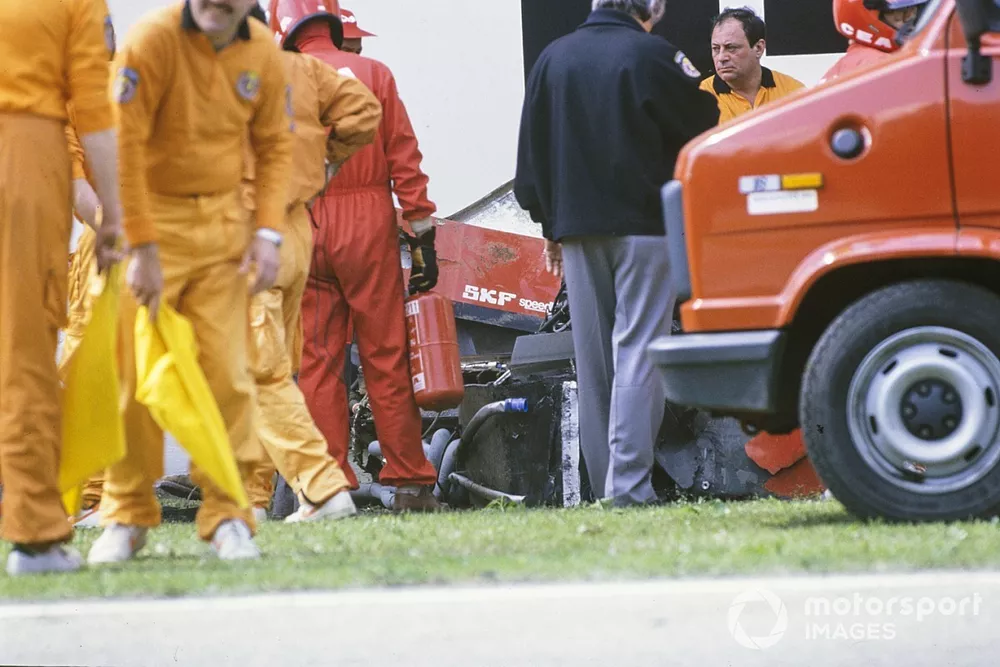
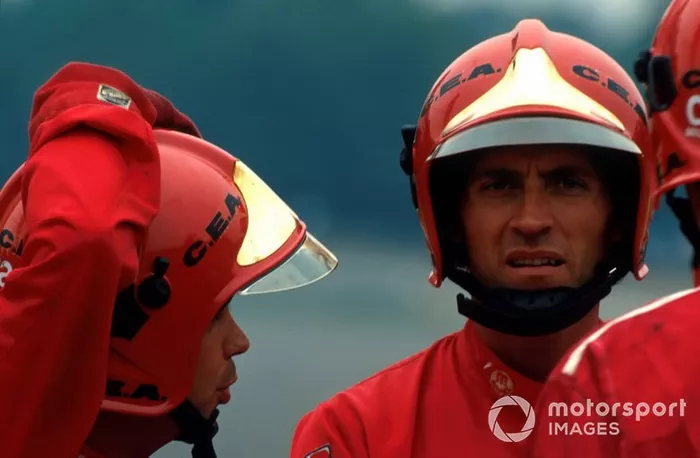
Everyone feared the worst as they watched the fire engulf the car, with the speedy arrival of fire marshals within seconds of the incident a significant factor in the Austrian driver's survival.
Berger, who had been left unconscious thanks to the ferocity of the crash, escaped with second-degree burns to his hands, bruises and cracked ribs. It was another wake-up call for F1 though.
For although the carbon-fibre monocoque, first introduced by John Barnard at McLaren in 1981, had absorbed the energy (believed to be as high as 100G) in the impact, the side exposure of the fuel tank had resulted in almost a full tank of fuel catching alight.

3
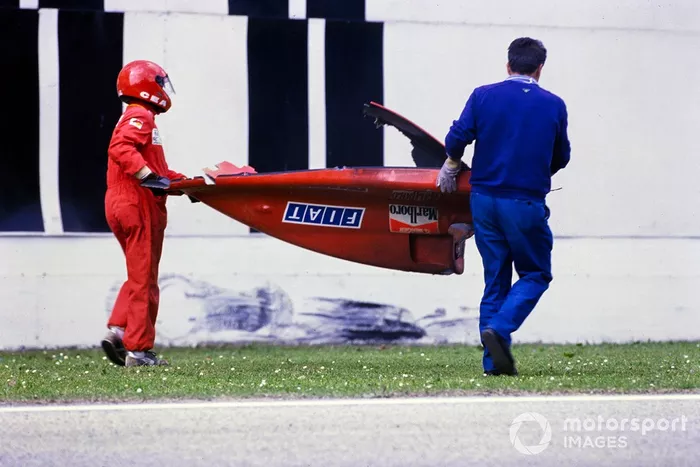
After the race, Ferrari's attention turned to finding out the cause of the accident, in order that it could prevent further occurrences.
It turned out to be a failure of the front wing, which had subsequently folded under the wheel and turned it into a sledge, driving straight-on into the wall.
Read Also:
- Ferrari will not accept reduced budget cap
- How F1's young driver record tumbled, and now can't be beaten
Barnard and his design team hadn't really factored-in Berger's exuberant kerb hopping driving style, with their calculations more or less focused on the forces being transferred in a downward direction, rather than the upwards trajectory it was forced when colliding with the kerbs.
Ferrari's technical director also cited as a factor the rule maker's decision to ban flexible front wing endplates [5], with the teams still using stiff versions for their aerodynamic effect: making them more susceptible to striking the ground and incurring damage.
Ferrari 640 front wing with John Barnard corrections
Photo by: Giorgio Piola
In preparing for the next race in Monaco, Ferrari made alterations to the wing's carbon lay up to strengthen the affected area. Its rapid response wasn't enough though, as Mansell's penchant for using the front wing as a guide, clipping the Armco barriers with it, resulted in a similar failure during practice.
Another hot fix later, which resulted in metal being inserted in the wing support tube, was readied for qualifying and latterly improved upon for the subsequent races.
Berger's accident proved to be a defining moment for F1 though, as the fire – live on the world television feed - led to regulatory changes going forward, with fuel tank and chassis changes the focus of the sport's efforts.
The designs used then had been a hangover from the less safety focused decades that preceded them, when fuel tanks were still allowed to occupy the space alongside the driver. This was a significant factor in this accident and one that was to be changed in the following years.
As part of an overhaul prompted by the Berger crash, the fuel tank would need not only to be wholly enclosed within the monocoque's structure, but a new bladder construction, impervious to incursion, had to be homologated to a strict safety level too.
The FT5 bladder is a standard still in use today. It is a pliable and lightweight construction of Kevlar fibres that are tightly woven and then coated with an advanced elastomer, allowing them to be inserted through a small window in the monocoque.

Side-by-side here we can see the differences in the 640, 641 and 642 chassis and their fuel tanks.

The carbon-fibre monocoque of the Ferrari 640 was made from a male mould, a process that Barnard had used with his first carbon car at McLaren and adopted once again for Ferrari. The construction of the monocoque helped to soak up the massive loads the car underwent in the crash.

The stillborn 639 underwent plenty of changes as the car morphed into the 640 for the ‘89 season.

This exploded view of the 640 shows the chassis and fuel tank relative to the rest of the car.

This cutaway of the 641 gives a comparison of how the chassis and fuel tank differs in design to the 640.
5
We want your opinion!
What would you like to see on Motorsport.com?
Take our 5 minute survey.
- The Motorsport.com Team
Read and post comments
Read also :
Share Or Save This Story
Copy link
Share on Viber
Previous article Honda reveals development secrets of 2021 F1 engine
Next article Red Bull Powertrains hires Mercedes man as technical director
Top Comments
There are no comments at the moment. Would you like to write one?
View More & Comment
More from
Giorgio Piola
The fascinating story behind McLaren's most iconic F1 car
Formula 1
Formula 1 Apr 3, 2024
The fascinating story behind McLaren's most iconic F1 car
Emilia Romagna GP: F1 technical images from Imola's pitlane
Formula 1
Formula 1
Emilia Romagna GP
Apr 21, 2022
Emilia Romagna GP: F1 technical images from Imola's pitlane
The F1 downforce choices that proved key at the Saudi GP
Formula 1
Formula 1
Saudi Arabian GP
Mar 29, 2022
The F1 downforce choices that proved key at the Saudi GP
More from
Gerhard Berger

Friday favourite: The long-standing F1 team-mates who crashed Todt's car
Formula 1
Formula 1 Dec 1, 2023
Friday favourite: The long-standing F1 team-mates who crashed Todt's car

Ferrari needs group around Binotto to win F1 titles - Berger
Formula 1
Formula 1 Jul 10, 2020
Ferrari needs group around Binotto to win F1 titles - Berger
When Hill conquered Imola for Williams in memory of Senna
Formula 1
Formula 1 Apr 30, 2020
When Hill conquered Imola for Williams in memory of Senna
Latest news

“He’s beaten Alpine on his own” - Racing Bulls on why it kept Liam Lawson
Formula 1
F1 Formula 1
Las Vegas GP
1 h
“He’s beaten Alpine on his own” - Racing Bulls on why it kept Liam Lawson

CrowdStrike Racing by APR keeps title-winning IMSA LMP2 roster intact for 2027
IMSA
IMSA IMSA 2 h
CrowdStrike Racing by APR keeps title-winning IMSA LMP2 roster intact for 2027
IndyCar 2026 season review: Team Penske
IndyCar
Indy IndyCar 2 h
IndyCar 2026 season review: Team Penske
Feature
Discover prime content


Subscribe and access Motorsport.com with your ad-blocker.
From Formula 1 to MotoGP we report straight from the paddock because we love our sport, just like you. In order to keep delivering our expert journalism, our website uses advertising. Still, we want to give you the opportunity to enjoy an ad-free and tracker-free website and to continue using your adblocker.
You have 2 options:
- Become a subscriber.
- Disable your adblocker.
Subscribe now Already subscribed? Sign in here
Already disabled your adblocker?
Reload page
Manage Alerts
Subscribe